Are Institutional Investors Buying Up Homes in Omaha? Here’s What the Data Actually Shows
If you’ve been following national housing headlines, you’ve probably seen claims that large institutional investors are buying up single-family homes and pushing everyday buyers out of the market.
It’s a real issue in some parts of the country. But the local data tells a much more nuanced story here in Omaha.
Let’s break down what’s actually happening.
How much of Omaha’s housing stock is owned by institutional investors?
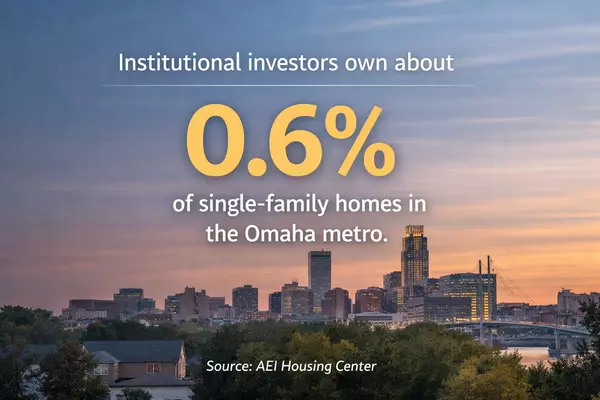
According to research from the AEI Housing Center, large institutional investors own about 0.6% of single-family homes in the Omaha–Council Bluffs metro.
That figure specifically refers to large investors, generally defined as entities owning 100 or more homes. It does not include small local landlords or individuals who own a handful of rental properties.
Using American Community Survey housing data as a baseline, that 0.6% works out to roughly 1,400 homes across the entire metro area.
That’s not zero. But it’s also a very small slice of Omaha’s overall housing market.
Why national headlines can be misleading
One reason this topic feels so urgent is because institutional investor activity is heavily concentrated in a small number of U.S. markets.
Roughly half of all investor-owned single-family homes nationwide are concentrated in just 14 metro areas. These tend to be fast-growing Sun Belt markets like Atlanta, Dallas, Houston, Phoenix, Charlotte, and Tampa.
Omaha simply isn’t one of those markets.
We don’t have the same level of institutional concentration, rapid population inflows, or large-scale build-to-rent activity that drives those headlines elsewhere.
Who is shaping Omaha’s housing market?
In Omaha, housing conditions are still driven primarily by:
-
Regular homeowners buying and selling
-
Small, local landlords
-
First-time buyers competing for entry-level inventory
-
Move-up buyers navigating affordability and interest rates
When buyers feel squeezed here, it’s usually because of limited inventory, rising construction costs, and affordability constraints — not because Wall Street firms are buying entire neighborhoods.
If affordability is the goal, what actually moves the needle locally?
If Omaha wants to improve long-term housing affordability, the biggest levers are local, not national.
That includes:
-
Reducing permitting delays and development friction
-
Revisiting zoning rules that limit housing variety
-
Making it more practical to build homes regular buyers can afford
-
Allowing density in the places people actually want to live
Omaha has land. It has demand. And it has people who want to put down roots here. The challenge is making it feasible to add supply without unnecessary cost and delay.
The bottom line
National housing debates matter, but local data matters more.
In Omaha, large institutional investors own a very small share of single-family homes. The forces shaping prices and competition here are much more about supply, affordability, and local policy decisions than about outside investors.
If you’re buying or selling in the Omaha metro, understanding local conditions will always be more useful than reacting to national headlines.
Recent Posts