
Omaha vs. Kansas City: An Honest Look for People Actually Making the Move
Quick answer
Cost of living between Omaha and Kansas City is close to a wash — within about 2%. The differences that actually show up day to day are commute, market speed, and income tax.
Omaha’s average commute runs about 20 minutes vs roughly 26 in Kansas City. Homes here sell in a median of 20 days at 99.8% of list, so you move faster and negotiate less. And as of 2026 Nebraska’s top income tax rate is 4.55% — now below Missouri’s ~4.7%, and scheduled to drop to 3.99% in 2027.
Omaha’s median existing home ran $305,500 over the 12 months through June 2026 (Great Plains Regional MLS). Property taxes are the real cost to watch — check the exact rate for any Omaha address.
Let me be upfront: Kansas City is a great city. Legitimately great barbecue. The Chiefs are a dynasty. Arrowhead is one of the loudest stadiums in football. There's an IKEA. I get it.
But I talk to a lot of people who are cross-shopping KC and Omaha, and the comparison is consistently closer than they expect — especially when you factor in what day-to-day life actually looks like. Omaha is smaller, no question. But smaller often means easier: shorter commutes, a housing market where your dollar still goes far, and neighborhoods where you can actually put down roots without navigating a metro that sprawls in every direction. If you're also comparing other cities, I've done similar breakdowns for Omaha vs. Denver and Omaha vs. Dallas.
Here's my honest take on both cities — as someone who lives in Omaha, loves it here, and isn't going to pretend KC doesn't have a lot going for it.
The Quick Numbers: Side by Side
| Category | Omaha, NE | Kansas City, MO |
|---|---|---|
| Metro Population | ~975,000 | ~2.2 million |
| Median Home Price | $305,500 existing-home median (12 mo through June 2026) | ~$240K city / higher in suburbs |
| Avg Days on Market (resale) | ~19 days | ~51 days |
| Cost of Living vs. National | ~8–10% below avg | ~8–10% below avg |
| Crime vs. National Avg | Near average city-wide; suburbs well below | 29% above national average (KC MO city) |
| Sports | Huskers (football, volleyball), College World Series | Chiefs, Royals, Sporting KC, plus college sports |
| Drive to Chiefs Games | ~2.5 hours on I-29 | You live there |
| Avg Commute | ~20 minutes | ~26 minutes |
| State Income Tax | Nebraska: 4.55% (2026), 3.99% in 2027 | Missouri: about 4.7% |
Sources: Redfin, MLS/MIBOR data spring 2026. Crime: KCPD 2025 annual report, NeighborhoodScout. Metro population figures approximate.
Cost of Living: Too Close to Call
Here's the honest version: Omaha and Kansas City are within 1–2% of each other on cost of living, depending on the source and the year. Both cities run roughly 8–10% below the national average. If you're making a budget-based decision, the difference between these two cities is not going to be the deciding factor — it's a wash.
Where you might feel a difference on specific line items: Nebraska’s top income tax rate is now 4.55% — down from 6.84% in 2022, and scheduled to fall to 3.99% in 2027 — which puts it just under Missouri’s roughly 4.7%. That is a reversal from a couple of years ago, and it matters most if you’re a high earner. On the other hand, Nebraska's LB 34 property tax credit — passed in 2024 — provides a meaningful offset on school district property taxes that KC residents don't have an equivalent for. Here's the full breakdown on how Omaha property taxes actually work.
The practical reality: you'll live affordably in both cities. What you're really choosing between is the specific tradeoffs — not a blowout in either direction.
Housing Market: Speed Is the Real Story
This is where the two markets diverge most clearly. In the Omaha resale market right now, well-priced homes still move quickly — around 19 days on average for existing homes, per MLS data. (The overall Omaha average, including new construction which tends to sit longer, runs closer to 31 days.) In Kansas City, homes are averaging about 51 days on market. That's not a small difference.
What that means practically: Omaha buyers need to be ready to move when they find the right house, but it also means the market here has a genuine competitiveness that supports long-term appreciation. If you're relocating on a timeline, Omaha's faster pace can actually work in your favor — less limbo, more certainty once you're under contract.
Omaha’s median existing home ran $305,500 over the 12 months through June 2026 (Great Plains Regional MLS). Kansas City's city-proper median is lower (around $240K), but most buyers in the KC metro land in the suburban Johnson County corridor — Overland Park, Leawood, Olathe — where prices come in considerably higher. In comparable suburban neighborhoods, the two metros are closer to even on price. For a deep look at what your budget gets you here, see what $500K buys in Omaha or browse homes under $300K.
Jobs and Economy: Omaha's Institutional Depth
Kansas City has a larger economy by simple math — the metro is more than twice the size. Major employers include Cerner/Oracle Health, Hallmark, H&R Block, and a significant federal presence. KC's tech scene has been developing steadily and it's been named an emerging tech market in recent years.
Omaha punches well above its weight economically. The city is home to four Fortune 500 headquarters — Berkshire Hathaway, Union Pacific, Kiewit, and Mutual of Omaha — but the real depth is in institutional employment. Nebraska Medicine, CHI Health, UNMC, Methodist Health System, and Children's Nebraska each employ 2,500 or more people here. Add Offutt Air Force Base, Omaha Public Schools, FNBO, Fiserv, Charles Schwab (which maintained a major Omaha operation after absorbing TD Ameritrade), Werner Enterprises, ConAgra, and PayPal, and you have a genuinely diversified base that holds up well in downturns. The metro's Fortune 500 companies are the headline, but it's the depth of institutional employers — healthcare, education, finance, government — that makes Omaha's economy as stable as it is.
If you're in healthcare, finance, insurance, or education, Omaha has remarkable depth for a city this size. If you're in tech, KC has a more developed scene — though Omaha's tech community has grown steadily and the talent competition here is considerably less fierce. See the full Omaha relocation guide for a deeper look at the job market.
Safety: A Meaningful Difference
I'll be direct here because a lot of comparison posts gloss over it. Kansas City MO's crime rate runs about 29% above the national average — and that's after real improvement in 2025, when the KCPD reported a significant drop in major crimes. The good news: the department's homicide clearance rate of 75% is well above the national average, and roughly 71% of KC's neighborhoods rate A or B for safety. The problem is concentrated in specific parts of the city — not in the suburbs.
Omaha isn't crime-free, and the city-wide numbers aren't perfect either. But the gap is real, and Omaha's suburban neighborhoods — Millard, Elkhorn, Papillion, La Vista, Bennington — post crime rates well below the national average. For families evaluating where to put down roots, that distinction matters.
Worth saying for both cities: crime statistics are always metro-wide averages. Where you buy within the metro matters far more than the city-level headline number. A family buying in Elkhorn and a family buying in Johnson County are probably living in similarly safe neighborhoods. The gap shows up most at the city-proper level.
Lifestyle: What You're Actually Trading
What KC has that Omaha doesn't
Professional sports is the biggest real difference. Chiefs, Royals, Sporting KC — if attending NFL and MLB games regularly is part of your identity, Omaha genuinely can't match that. The barbecue scene in KC is legitimately world-class. And KC's Crossroads Arts District and entertainment density give it a cultural energy that Omaha's downtown is still building toward. There's also a handful of major retailers and attractions — including the IKEA everyone mentions — that don't exist in Omaha.
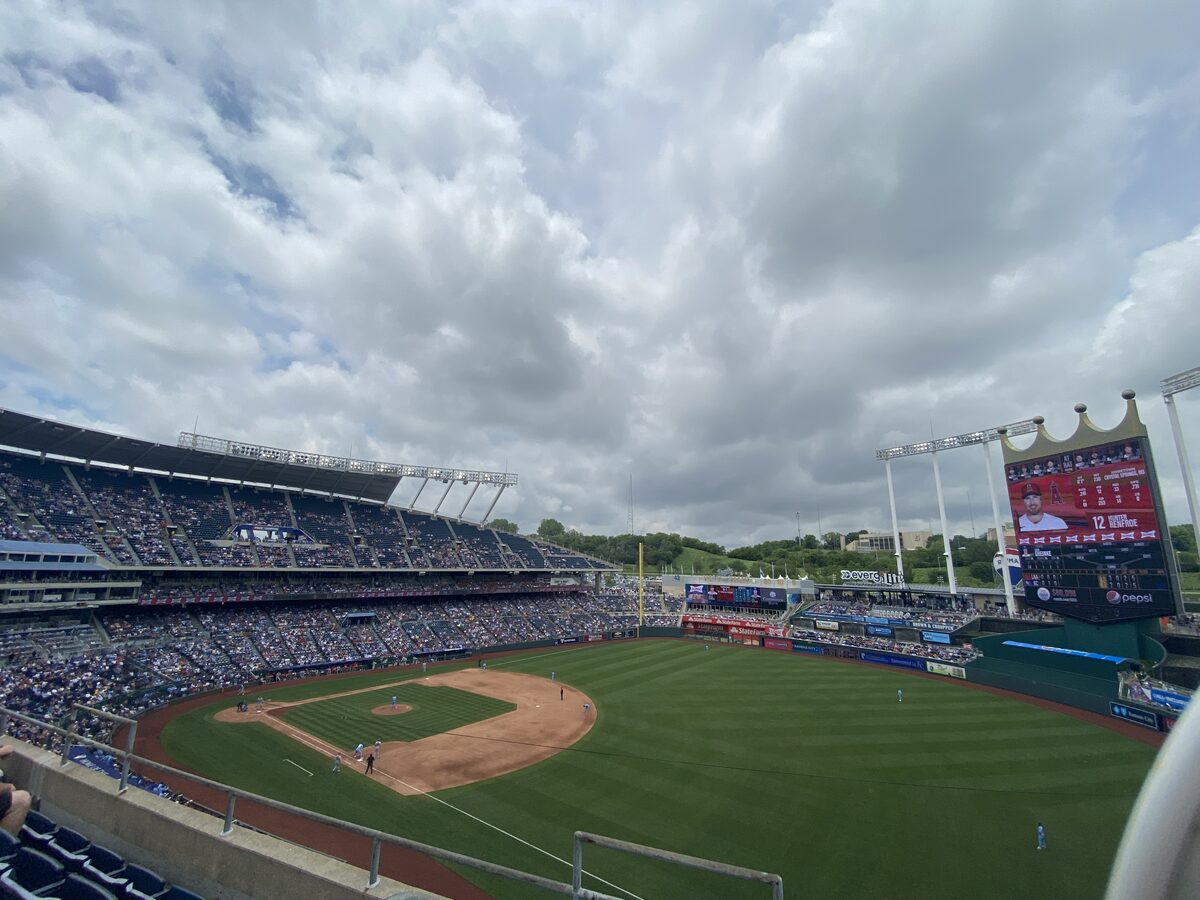
Kauffman Stadium — home of the Royals
What Omaha has that surprises people
Most KC transplants find that Omaha delivers essentially the same quality of life they had in KC — same caliber of restaurants, entertainment, and day-to-day conveniences — minus the pro sports and a few larger-market amenities. What they don't expect is how easy it is. Parking isn't a fight. Getting across town doesn't ruin your evening. The west side suburbs — Elkhorn, Papillion, Millard — have great schools, new construction at competitive prices, and short commutes to most of the city's major employers.
College sports here are not a consolation prize — they're a way of life. Husker football fills a 90,000-seat stadium in Lincoln on Saturdays, and Husker volleyball is arguably the best program in the country. Every June, Omaha hosts the College World Series, turning the downtown area into one of the best two-week sporting events in the country.
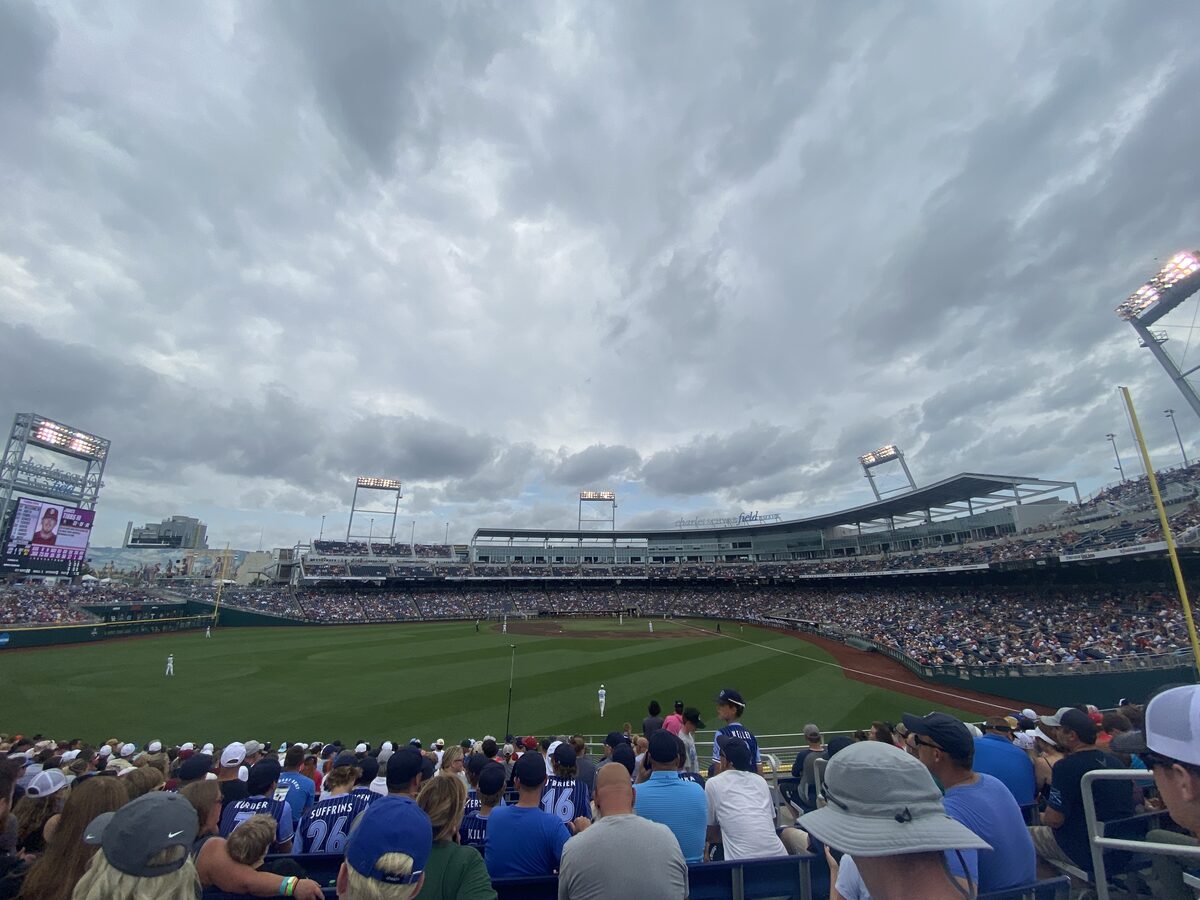
The College World Series, downtown Omaha
The zoo is legitimately world-class. The food scene in Dundee, Benson, and the Blackstone District has gotten seriously strong. And Aksarben has developed into a walkable restaurant-and-entertainment corridor that didn't exist 15 years ago.

Benson's entertainment strip at night
"We hit above our weight for entertainment, restaurants, and quality of life. People who move here say the same thing: it's easy. And for a certain kind of person, that ease is worth a lot."
And the Chiefs fan situation, practically: there's no competing NFL team in Omaha, so Chiefs fans are everywhere here. Game weekends you'll see caravans heading south on I-29. The 2.5-hour drive to Arrowhead is straightforward, and plenty of people make it regularly. It's not the same as living in KC — but it's not the sacrifice people assume it is.
Free Download
Free Omaha Home Buyer's Guide
A practical roadmap through every stage of buying — from pre-approval to closing — with local Omaha tips you won't find anywhere else.
Download Free →Who Should Choose Omaha
- Families who want excellent suburban schools, competitive housing costs, and commutes that don't eat your evenings — Omaha's western suburbs are hard to beat
- Healthcare, finance, and insurance professionals — the employer depth here is exceptional relative to city size
- Remote workers who want big-city amenities without big-city friction and cost
- College sports fans who love football, volleyball, and baseball — Husker culture is the real deal, and the College World Series every June is a genuine bucket-list event
- People who value community and ease over metro scale — Omaha is a city that punches above its weight, and people who move here tend to stay
Who Should Choose Kansas City
- Pro sports fans for whom NFL and MLB games are a meaningful part of life — there's no substitute for having the Chiefs and Royals in your backyard
- Tech professionals who want a more developed ecosystem and startup scene
- Urban density seekers — KC's Crossroads and Brookside neighborhoods offer a city experience Omaha's downtown is still working toward
- Anyone who genuinely needs IKEA within 20 minutes — that one's real
Frequently Asked Questions
Is Omaha cheaper than Kansas City?
It's essentially a wash. Both cities run roughly 8–10% below the national cost-of-living average, and current data puts them within 1–2% of each other overall. Missouri's income tax rate is slightly lower than Nebraska's, which matters for high earners. Nebraska's LB 34 property tax credit partially offsets that. Day-to-day, you'll live affordably in both cities — the difference isn't a deciding factor.
Can I still follow the Chiefs if I move to Omaha?
Absolutely — and you probably will. There's no competing NFL team in Omaha, so Chiefs fans are everywhere here. The drive to Arrowhead is about 2.5 hours on I-29 and plenty of people make the trip for big games. Most sports bars are full of red on game day.
How do the suburbs compare between the two metros?
Both metros have strong suburban options with similar build quality and demographics. Omaha's west side — Millard, Elkhorn, Papillion, Bennington — offers excellent schools, newer housing stock, and very low crime. KC's Johnson County corridor (Overland Park, Leawood, Lenexa) is comparable in vibe and quality. The main practical difference is that Omaha's suburbs tend to come at somewhat lower price points for comparable product.
Which city is better for job seekers?
It depends on your field. KC has a larger economy overall and a more developed tech sector. Omaha is exceptional for healthcare, finance, insurance, and education — the institutional employer base here is remarkable for a city this size. Both metros have low unemployment and stable job markets relative to national trends.
What is Omaha actually missing compared to Kansas City?
Professional sports is the honest answer — no local NFL or MLB franchise means if attending those games regularly is your lifestyle, KC wins that one outright. KC's barbecue scene is legitimately world-class in a way Omaha's isn't quite (though the food scene here has gotten seriously good). And a handful of major retailers and attractions — including IKEA — that don't exist in Omaha. That said, most KC transplants are surprised by how similar the day-to-day experience actually is once they get here.
Considering a Move to Omaha?
Let's talk neighborhoods, price points, and what life actually looks like here. No sales pitch — just a straight conversation.
Recent Posts