
How to Appeal Your Douglas County Property Tax Assessment (2026 Step-by-Step)
Every January, Douglas County mails out preliminary valuation postcards — and every year, some homeowners flip theirs over, see the assessed value jumped $30,000, and think: that can't be right. If that's you, you have options. There's an informal review window in the late winter and a formal protest period in June. But winning one takes more than a gut feeling. Here's exactly how the process works in 2026 — plus the honest answer to whether it's even worth your time.
What This Post Covers
The real 2026 timeline — preliminary postcards in January, the formal protest window June 1–30 — the evidence that actually moves a referee, and the one mistake that can raise your taxes instead of lowering them.
Should You Actually Bother? The Honest Answer First
Before you invest any time in this, let's be straight: protests based on how you feel about your taxes don't win. The Douglas County Board of Equalization looks at facts — comparable sales, property records, appraisals. If the facts support your case, you have a real shot. If you're going in with "this just seems high," you'll likely walk away with the same number.
The clearest wins fall into two buckets: there's a verifiable data error in your property record, or recent comparable sales in your neighborhood genuinely don't support the assessed value. Here's a simple way to size up your situation:
| Your situation | Worth protesting? | Why |
|---|---|---|
| Data error in your county record (wrong sq ft, bed/bath, etc.) | Yes | Facts are squarely on your side — but read the warning below first |
| You recently bought the home for less than the assessed value | Yes | Closing docs are among the strongest evidence you can submit |
| Comparable sales in your area don't support the value | Yes, if documented | A solid comp package or licensed appraisal can make the case |
| Assessment is below what you'd sell for today | No | You could trigger a correction that raises it |
| It just feels too high | No | The BOE needs evidence, not impressions |
The Warning Nobody Mentions: Check Your Record First
"The most common mistake I see is a homeowner who goes looking for an error to lower their taxes — and instead discovers the county has been undervaluing them. File a protest, the referee catches it, and now your taxes go up, not down."
Before you file anything, pull up your property record at the Douglas County Assessor's website. Verify the square footage, bedroom and bathroom count, basement finish, and garage. If those details are wrong in your favor — meaning the county thinks you have less than you actually do — protesting opens a door you don't want opened. The assessor can correct the record in either direction.
On the other hand, if the record overstates your home — shows a finished basement you never finished, an inflated garage, bathrooms that don't exist — that's a legitimate factual error worth correcting, and it should bring the valuation down.
The Real 2026 Timeline
This is where the original version of this guide tripped people up, so let's be precise. The postcard you get in December is your tax statement — the bill for last year's value, and far too late to protest. The number you actually protest shows up earlier, and Nebraska runs on a delay: the value you challenge this June is what your 2027 tax bill gets built on (we pay in arrears here).
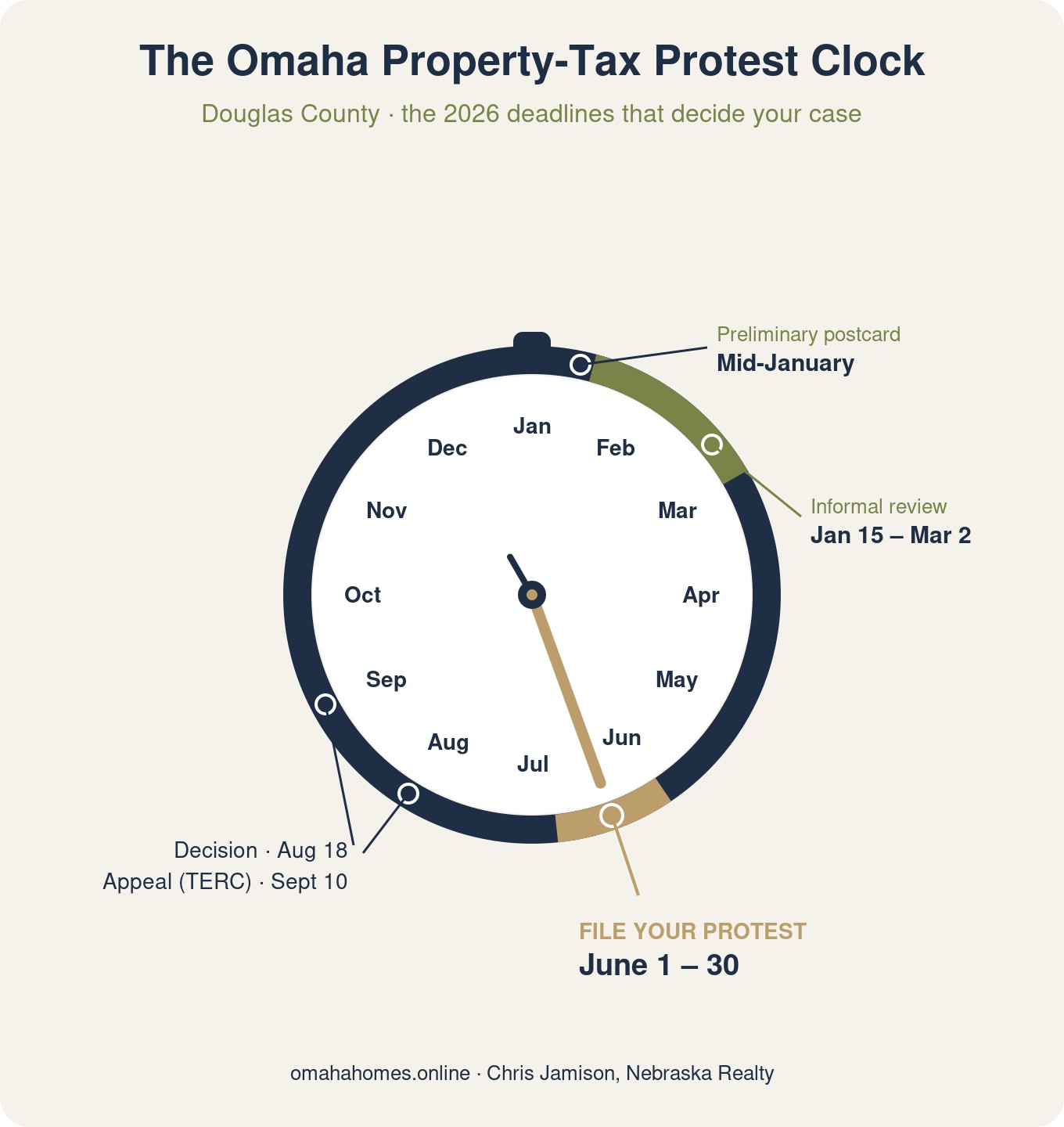
| When | What happens |
|---|---|
| Mid-January | Preliminary valuation postcard arrives — your first look at any increase. Most people find out about a hike right here. |
| Jan 15 – March 2 | Informal review window with the Assessor's office — schedule it right off that postcard. A clear data error can sometimes be fixed here without a formal protest. |
| By June 1 | The Assessor finalizes 2026 values and mails an official valuation notice — but only to owners whose value changed. Final values post to the county's Valuation Lookup. |
| June 1 – 30 | Formal protest window with the Board of Equalization. File online until 11:59 PM June 30, or mail (postmarked by the 30th) or hand-deliver to 1819 Farnam St. No exceptions on the deadline. |
| August 10 | The BOE sets final valuations on every protest it reviewed. |
| August 18 | The county mails written decision notices to protesters. |
| September 10 | Last day to appeal the BOE's decision to the state (TERC). |
Step-by-Step: How the Protest Actually Works
Step 1 — Look up your value now. Your 2026 value is posted at the Douglas County Assessor's website. Compare it to what you know about your home and what similar homes nearby have sold for recently. If something looks off, note the gap — that's your benchmark.
Step 2 — Use the informal window if you can (Jan 15–March 2). If you caught your increase on the January postcard, schedule an informal review with the Assessor's office. A clear data error can sometimes be corrected right there, no formal protest needed. This window closes well before June, so don't sit on it.
Step 3 — Build your evidence package. This is where protests are won or lost. The strongest submissions include comparable sales from your area (ideally dated close to January 1, Nebraska's statutory assessment date), a recent professional appraisal if you have one, condition photos for anything that affects value, and your closing statement if you bought recently. Organize it simply: a one-page summary up front with your requested value and your top two or three reasons, then clearly labeled exhibits behind it.
Step 4 — File in June. Starting June 1, file your protest and evidence through the BOE's online portal at boe.douglascounty-ne.gov. You are not required to appear in person — the BOE reviews your documentation without a hearing. (A 15-minute referee appointment is available if you want one, but it's optional.) The window closes June 30, so don't wait until the last week.
Step 5 — Wait for the decision, then weigh TERC. Decisions are mailed by August 18. If you're not satisfied, you have until September 10 to appeal to Nebraska's Tax Equalization and Review Commission (TERC). TERC is more formal — worth it only if your evidence is strong and the dollar difference justifies the effort.
The Evidence That Actually Moves the Needle
Referees aren't moved by your neighbor's tax bill or a Zillow estimate. What actually works:
- Comparable sales near January 1. Three to five solid comps — close in size and condition, with values below your assessment. The closer to January 1 of the tax year, the better.
- A licensed appraisal. Submit the full report, not just the summary. If you refinanced recently and it came in below your assessed value, that's real evidence.
- Your closing statement. If you bought in the past year or two for less than the assessed value, submit the settlement docs. The county gives real weight to an arm's-length sale price.
- Condition documentation. Foundation issues, major systems near end of life, deferred maintenance — photos paired with contractor estimates help quantify the hit to value.
- Property record corrections. Wrong square footage, a basement wrongly listed as finished, an inflated garage. Clean factual errors that overstate your home are the easiest wins.
The single most useful thing you can do before you file is get a fresh set of comparable sales. If you have an agent, ask them to run a CMA on your property — most of us will do it in about 15 minutes, and it'll tell you fast whether you actually have a case. Don't have an agent? That's what the offer at the bottom of this post is for.
Free Download
Free Omaha Home Seller's Guide
Step-by-step guide to pricing, timing, and maximizing your net proceeds when selling in the Omaha market.
Download Free →A Note on SID Neighborhoods
If you bought in a newer subdivision, part of what's driving your bill may not be your valuation at all — it's your SID levy. Sanitary Improvement Districts can add anywhere from a few hundred to $8,000+ a year, and they're separate from your assessed value, so protesting won't touch them. It's worth knowing the difference before you assume the assessment is the problem. I break the whole thing down in the Omaha SID Tax Guide, and you can compare real tax-and-SID costs across the metro on my Nebraska Property Taxes tool.
What About Council Bluffs and Pottawattamie County?
If your home is on the Iowa side — Council Bluffs, Carter Lake, or anywhere in Pottawattamie County — the appeal process works differently: different forms, different deadlines, a different board. Start with my Iowa Property Taxes guide for Council Bluffs & SW Iowa, and reach out if you want a read on your specific assessment.
Do I have to show up in person to protest my Douglas County assessment?
No. The entire process can be done online through the BOE's portal — you submit your protest and evidence digitally, and the BOE reviews it without requiring a hearing. A 15-minute referee appointment is available if you want one, but it's optional.
When exactly can I file my protest?
Formal protests must be filed between June 1 and June 30, 2026. Online filing is open until 11:59 PM on June 30; mailed protests must be postmarked by the 30th. There are no exceptions to the deadline.
What if I find out the county has me undervalued when I check my record?
Don't file. If your record shows less square footage, fewer bathrooms, or a smaller garage than you actually have, a protest draws attention to the gap — and the assessor can correct it in either direction. If the county is undervaluing your home, leave it alone.
Can I protest a property I don't own?
Yes. Nebraska law allows anyone to file a protest on any real property in Douglas County. If you're signing on behalf of the owner, you'll need to include written authorization; if you're not authorized, the county notifies the owner.
What happens if the BOE denies my protest?
You can appeal to Nebraska's Tax Equalization and Review Commission (TERC) by September 10, 2026. TERC is more formal than the BOE process, so it's typically worth pursuing only if your documentation is strong and the dollar difference justifies the extra time.
Not Sure If Your Assessment Is Worth Fighting?
Ask your agent to run a CMA on your property — or if you don't have one, drop your info here and I'll pull your comps and give you an honest read on whether you've got a case. Free, no obligation.
Recent Posts