Is It Worth Hiring a Real Estate Agent in Omaha? (2026)
If you've ever Googled "is it worth paying for a real estate agent," you're in good company. Between Zillow, Redfin, and a year of headlines about lawsuits and commission changes, it's fair to wonder whether hiring an agent still makes sense — or whether you'd be smarter to keep that money in your pocket. I'm Chris Jamison, a full-time agent here in Omaha, and I'd rather give you an honest answer than a sales pitch. So here's what an agent actually does, what the data says it's worth, how to pick a good one, and how commissions really work now that the rules have changed.
What This Post Covers
Whether an agent is actually worth the money in 2026, how to tell a good one from a forgettable one, and how buyer's-agent commissions work after the NAR settlement — for both Omaha buyers and sellers.
An Agent Does a Lot More Than Open Doors
Most people picture an agent as someone who unlocks a house and hands you a contract. That's maybe 5% of the job. The rest is the part you rarely see: running real sold comparables to figure out what a home is actually worth today, spotting problems on a walkthrough before they become your problem, keeping the lender, title company, inspector, and the other agent all moving on the same timeline, and knowing when to push hard in a negotiation versus when to let something go.
I usually describe it as wearing a dozen hats at once — part market analyst, part project manager, part therapist. When a deal goes smoothly, you might not notice all the moving pieces. When it doesn't, having someone experienced in your corner is the difference between a sale that closes and one that quietly falls apart two weeks before you were supposed to move.
"Sending listings online is the least valuable thing I do. The real work happens when I'm walking through a home with you — pointing out what matters, what doesn't, and putting together an offer that wins without giving away more than you need to."
For a little local context, here's the market that work is happening in right now:
Is It Actually Worth the Money? Here's the Data
The fairest way to answer "is it worth it" is to look at how the homes that skip an agent actually do. Every year, some sellers go the for-sale-by-owner (FSBO) route to save on commission, and every year the numbers tell a pretty consistent story.
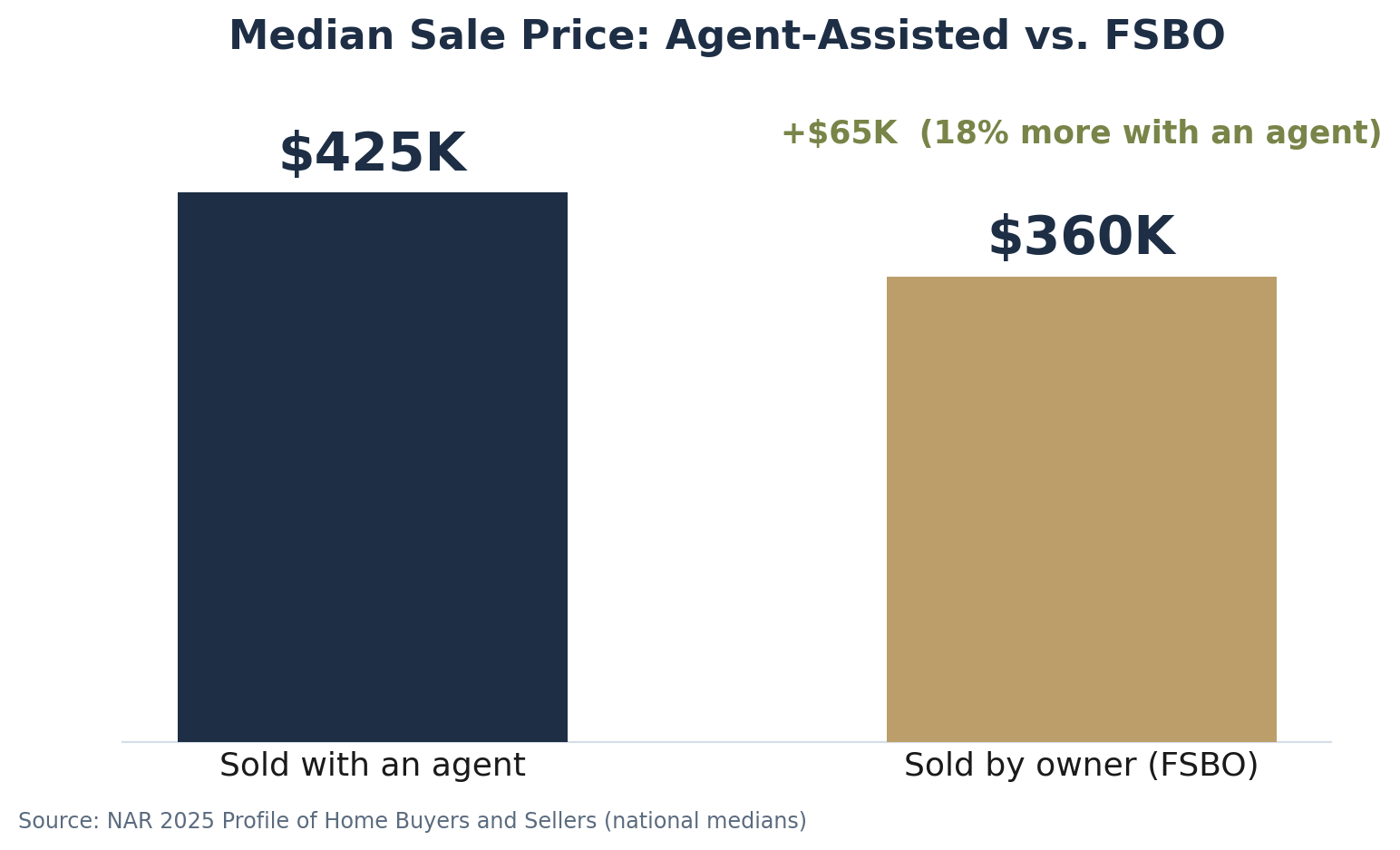
According to NAR's 2025 Profile of Home Buyers and Sellers, agent-assisted homes sold for a median of $425,000 while FSBO homes sold for $360,000 — an 18% gap that, in most cases, dwarfs what a seller would've paid in commission. That gap shows up year after year, not just once.
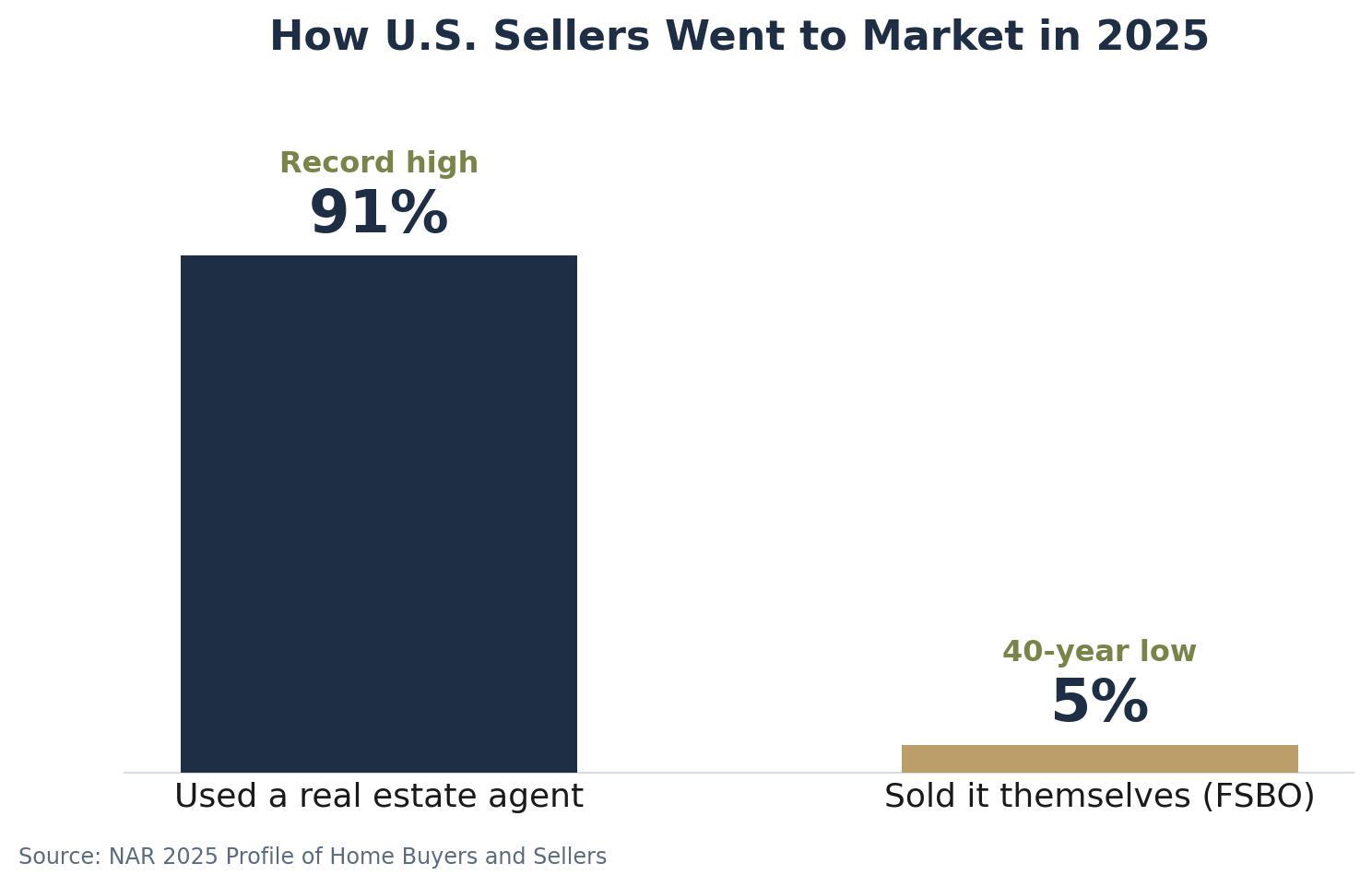
It's not just price. The same report found FSBO listings dropped to just 5% of all sales — a 40-year low — while 91% of sellers used an agent, the highest share ever recorded. When the do-it-yourself tools have never been better and people are still choosing to hire a pro at record rates, that tells you something about how the math actually shakes out in the real world.
Why the gap? FSBO sellers tend to lean on a Zestimate or gut feel instead of real sold data, so they misprice — and an overpriced home sits, goes stale, and ends up selling for less while the owner keeps paying taxes, insurance, and maintenance the whole time. It's one of the more avoidable outcomes in real estate.
What This Looks Like If You're Buying
For buyers, the temptation is a little different. You've found the perfect house on Zillow, driven by it twice, and you're ready to make an offer. Why pay for an agent at this point?
Here's what usually happens. The Zestimate told you the home is worth X, but it doesn't know about the moisture issue in the basement, that this particular Omaha pocket has been appreciating faster than the algorithm realizes, or that there are already two offers on the table. Without someone walking through homes with you week in and week out — someone who can tell a dealbreaker from a cosmetic fix and read a competitive situation — you're making one of the biggest financial decisions of your life with half the picture.
The riskiest version of this is calling the number on the sign and walking in unrepresented. The listing agent works for the seller. That's not a knock on them — it's just how agency works. Without your own representation, you're negotiating against someone whose entire job is to get their client the best outcome, which is not the same as looking out for you. (Using that same listing agent to represent you too is called dual agency. It's legal in Nebraska, but their first obligation is still to the seller, so you're not really getting an advocate of your own.)
Local knowledge is the other piece you don't get from an app. Dundee — older homes, tree-lined streets, walkable to coffee — feels nothing like a newer build out in Elkhorn, and Benson has a different energy than Papillion. None is objectively better, but they're not interchangeable, and a similar home can show up in very different parts of town at very different prices. A good local agent helps you realize the neighborhood matters as much as the house — and steers you out of the one that looks great on paper but doesn't fit how you actually live. If you're early in the process, the neighborhood quiz is a low-pressure way to start narrowing it down.
How to Choose the Right Agent in Omaha
If the data says an agent is worth it, the next question is the one that actually matters: which agent? Most buyers and sellers never interview more than one — 80% of sellers in that NAR report talked to exactly one agent before hiring. A few things to look for before you commit:
- Are they full-time — and do they have time for you? Those are the two questions I wish more people asked me. A license doesn't equal current, week-to-week market knowledge, and even a great agent who's stretched too thin can't give your deal the attention it needs. Ask both directly.
- Can they speak to your specific neighborhood right now? Ask what's selling fast and what's sitting in the area you care about. A well-connected Omaha agent gives you a real, current answer — not a talking point. If it's vague, that tells you something.
- Are they focused on moving right, not just moving fast? An agent who rushes you past questions you should be asking is working toward a commission, not toward your best outcome.
- Is it just someone you know with a license? Working with a friend or relative feels convenient until the deal gets complicated. Make sure whoever represents you has your interests as the clear priority — not the relationship.
It's also worth a few minutes on an agent's reviews and past-client testimonials — and not just the star rating. Read what people actually say. Were they responsive? Patient with first-timers? Genuinely knowledgeable about specific neighborhoods? Those specifics reveal far more than a five-star average ever will.
Free Download
Free Omaha Home Buyer's Guide
A practical roadmap through every stage of buying — from pre-approval to closing — with local Omaha tips you won't find anywhere else.
Download Free →The Commission Question After the NAR Settlement
This is the part everyone's been reading about. After the NAR settlement took effect in August 2024, the rules around buyer's-agent commissions changed. The two practical changes for Omaha: buyers now sign a written agreement with their agent before touring a home, and offers of buyer-agent compensation are no longer posted on the MLS. Commissions are negotiated deal by deal, they're fully negotiable, and they're not set by law.
A lot of buyers see "sign an agreement before we even look" and feel some hesitation. I actually think it's a good thing. Putting it in writing weeds out the tire-kickers and puts a little seriousness behind a showing — when someone's willing to sign, we both know we're working together, and I can pour real energy into finding them the right home instead of hedging.
So who pays? In my experience, that hasn't really shifted in 2026 — in the vast majority of deals, the seller still covers the buyer's-agent fee. Sellers have more flexibility than they used to, and it's genuinely negotiable, but the market still tends to land there because that's what keeps a home competitive and attracts the most buyers. Here's how I handle it with my buyers: we spell out my compensation clearly in the agreement, and if it ever becomes the thing standing between you and the right home at the right price, my fee won't be the dealbreaker. My job is still to get you into the right house.
If you're selling, the flip side matters: build the buyer's-agent piece into your net-proceeds math up front so there are no surprises at the closing table. I've had sellers want to push back on it, we listed, and every offer that came in still asked for it to be covered — so going in with realistic numbers beats getting surprised later. A free home valuation is the best place to start seeing those numbers for your specific home.
What This Looks Like If You're Selling
The number-one thing sellers told NAR they wanted from an agent — above pricing, above timelines — was help marketing their home. That's not a vague idea. For my listings it usually comes down to targeted social ads (precise targeting by location and buyer behavior) or reverse prospecting, where I pull up which agents in the MLS already have active buyers looking for a home like yours and reach out directly. That's getting in front of the right people, not just more people.
"There's a big difference between getting your home in front of more people and getting it in front of the right people. One generates showings. The other generates offers."
I showed a FSBO recently where a landlord had listed a rental on Facebook Marketplace. The listing photos were from when the unit was vacant, but tenants were still living there when we showed up — cluttered, awkward, the landlord and tenants both in the room. The buyers walked out already comparing it to every staged, properly marketed home they'd toured. It didn't even make their list. That's what happens when the presentation piece gets skipped; it's not just photos, it's every touchpoint a buyer feels before they decide to make an offer.
And the trust piece is real, especially here. 66% of sellers hired someone they already knew or who came recommended. In Omaha — particularly in close-knit areas like Millard and Papillion where neighbors actually talk — a good experience becomes a dinner-table conversation. The way I see it, my job is to walk alongside you as a guide, not a salesperson: you make the decisions, I make sure they're well-informed ones. You can see more about how I work on the selling page.
Is it worth hiring a real estate agent in Omaha's current market?
For most people, yes. Nationally, agent-assisted homes sold for a median of $425,000 versus $360,000 for FSBOs in 2025 (NAR) — an 18% gap that usually outweighs the commission. With well-priced Omaha homes still going under contract in roughly 18 days, pricing accuracy and offer strategy matter even more than they do in a slow market, and that's exactly where an experienced local agent earns their keep.
Does it cost a buyer anything to use a real estate agent in Omaha?
Since the NAR settlement, buyers sign a written agreement with their agent before touring that spells out compensation, and commissions are fully negotiable. In practice, in the large majority of Omaha transactions the seller still covers the buyer's-agent fee, so it typically doesn't come out of the buyer's pocket at closing. Any good agent will walk you through exactly how it works before you start looking.
How do I choose a good real estate agent in Omaha?
Interview more than one. Ask whether they're full-time and whether they genuinely have time for you, and ask what's selling and what's sitting in your specific neighborhood right now — a real, current answer beats a talking point. Read their reviews for specifics about responsiveness and local knowledge, and make sure whoever represents you has your interests as the clear priority, not just a personal relationship.
How does buyer's-agent commission work after the NAR settlement?
As of August 2024, agents and buyers sign a written agreement before touring homes, offers of compensation are no longer listed on the MLS, and commissions are negotiated deal by deal and are not set by law. Sellers have more flexibility than before, but most Omaha offers still come in with the buyer's-agent fee being covered, because that keeps a listing competitive. The key for sellers is to build it into your net-proceeds math up front.
What are the biggest risks of selling without an agent (FSBO) in Omaha?
Pricing, presentation, and paperwork. FSBO homes sold for a median of $65,000 less than agent-assisted homes nationally in 2025, and local FSBOs tend to sit longer and draw fewer qualified buyers. Without sold-data pricing and real marketing, sellers often misprice, make a weak first impression, and pay carrying costs longer — usually losing more than they would've spent on commission.
What's the difference between a Realtor and a real estate agent?
A real estate agent is licensed by the state to represent buyers and sellers. A Realtor is also a member of the National Association of Realtors and is bound by an additional code of ethics. All Realtors are licensed agents, but not all agents are Realtors. Either can represent you well — what matters most is experience, full-time focus, and real local knowledge of the Omaha market.
Thinking About Buying or Selling in Omaha?
Let's talk through your situation — no pressure, just an honest conversation about where you're headed and how I can help.
Recent Posts