How to Research an Omaha Neighborhood Before You Buy (Free, and From Anywhere)
If you're moving to Omaha from out of town, you might get one weekend here to pick a house. Maybe not even that. The good news: you can learn a surprising amount about a neighborhood before you ever set foot in it, and almost all of it is free. Here are the seven things I'd check from your couch, plus what to save for when you're actually in town.
One quick note on what this post isn't. The house itself (roof, foundation, radon, the sewer line) is what the home inspection is for, and I cover that in my Omaha home inspection guide. This one is about the street, the block and the part of town around it.
Seven Free Checks, From Anywhere
1. Take a virtual drive · 2. Look back in time · 3. Check the sun and shade · 4. Test the commute · 5. Pull up the flood map · 6. Figure out the real tax bill · 7. Look at crime data and the neighborhood chatter (calmly)
1. Take a Virtual Drive on Google Street View
This is my favorite one, and it's the closest thing to driving the neighborhood yourself. Drop the little yellow person onto the street in Google Maps and just start clicking down the block. Then keep going a few blocks in every direction.
You're snooping, so snoop. Are the yards kept up? Are there sidewalks, and do they connect to anything? Is there a busy road, a commercial strip or a set of railroad tracks two blocks over that the listing photos left out? Where's the closest grocery store, coffee shop or park? Listing photos are taken from the best angle in the best light. Street View doesn't care.
2. Look Back in Time
Here's the trick most people don't know. On a computer, Street View has a "See more dates" option (look for the clock icon or the date in the corner). Click it and you can see the same spot as it looked years ago.
That tells you things the listing won't. Was this house a rough-looking rental four years ago and freshly flipped now? Was there a big shade tree in the front yard that's gone? Has the block been steadily fixing up, or slipping? Did the empty lot across the street turn into something? It's a free time machine. Use it.
3. Check the Sun and Shade
You tour a house on a nice afternoon and it feels perfect. What you can't see on that visit is how the sun moves across it in other seasons. There's a free tool called ShadeMap that simulates the shadows from buildings, trees and terrain for any date and time. Search the address, pick a date and slide through the day.
- Try a day in mid-January. Does the driveway ever see the sun, or does a north-facing slope and the neighbor's two-story keep it shaded all day? That's the difference between snow melting off on its own and a sheet of ice until March.
- Now try mid-July, around 5pm. Is your back deck going to get blasted while you're trying to grill? A west-facing deck with no trees can be unusable on summer evenings without a shade sail or a pergola.
- Turn on "Hours in the sun" in the Layers menu for the day's total. It's a quick read on whether the backyard can grow a garden, which rooms get morning light, and whether solar panels are worth a quote.
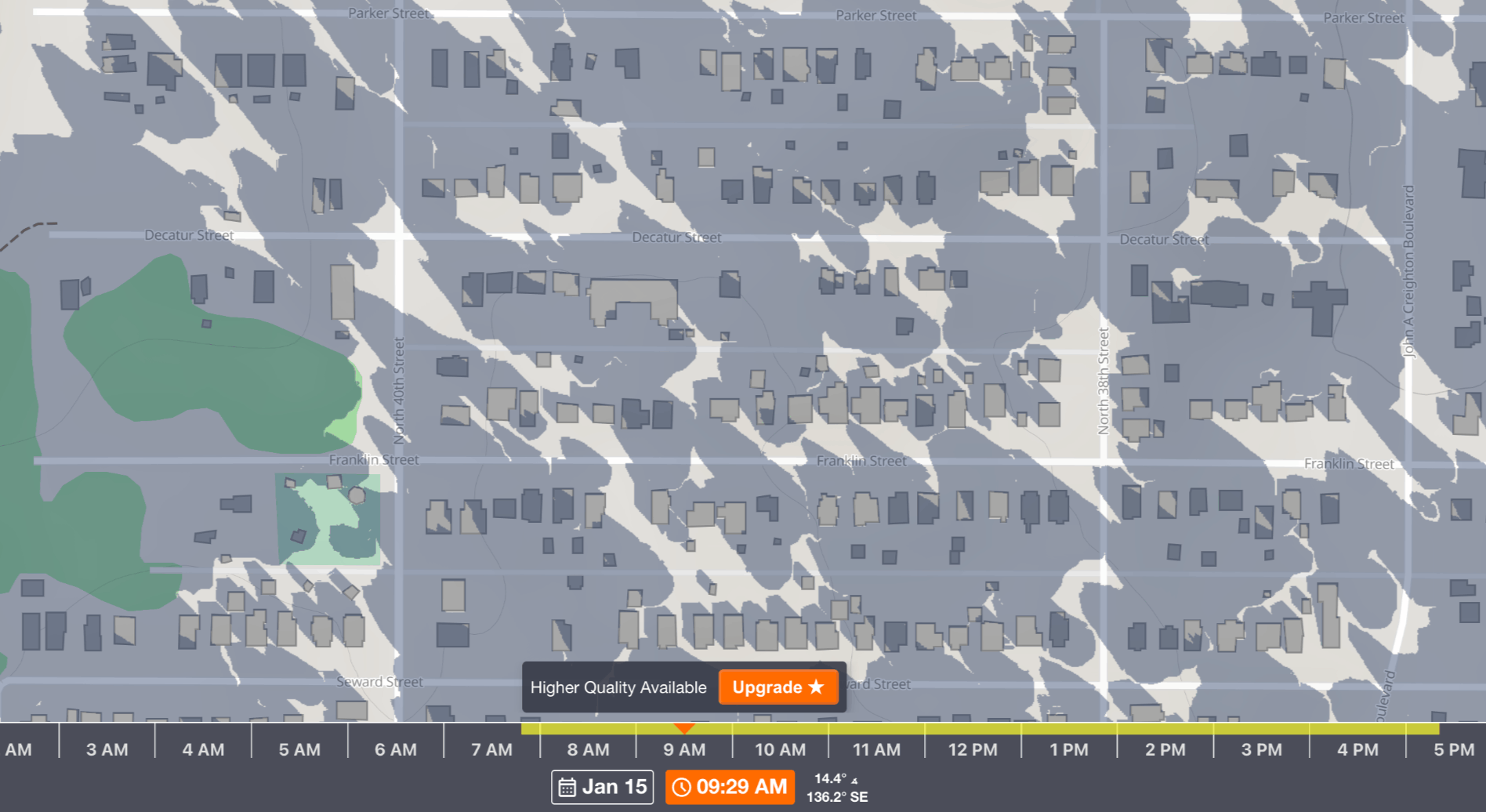
ShadeMap, Jan. 15 at 9:29am, around North 40th and Franklin Streets.
On a January morning in Omaha, the sun is so low that most of a typical block sits in shadow. That's normal. What you're looking for is the spot that never comes out of it. One honest caveat: ShadeMap's tree data is estimated and can be off by several meters, so treat it as a gut check, not gospel.
4. Test the Commute at Rush Hour
Put in directions from the house to your new job, then change "Leave now" to "Depart at" 7:30am on a Tuesday. Do it again for the drive home at 5pm. Google's estimate at midnight is a fantasy. The rush-hour one is your life.
The good news, and I tell every out-of-town buyer this, is that Omaha's version of "bad traffic" is pretty tame compared with most bigger cities. But there's still a real difference between a 15-minute drive and a 35-minute one, and it's usually about which side of town you're on and which way you're headed. Do the same check for daycare, school drop-off and the gym if those are part of your week.
5. Pull Up the Flood Map
You can look up any address on FEMA's Flood Map Service Center or on the Nebraska Department of Natural Resources' floodplain map, which is a little easier to click around. Two things to know here:
- The maps around the Papio creeks have been getting redrawn. FEMA has issued preliminary maps for the Omaha area over the last few years, and when new ones take effect, some homes move into a high-risk zone and some move out. Look at the current map and the proposed one.
- A high-risk zone changes your monthly payment. If the home is in one and you're using a federally backed mortgage, your lender will require flood insurance. You want that number before you write an offer, not after.
6. Figure Out the Real Tax Bill
The tax number on a listing is last year's bill for the last owner. If you're coming from a state with low property taxes, this is the one to get right, because three things can make your bill very different:
- An SID. A lot of newer subdivisions in west Omaha and Sarpy County sit in a Sanitary Improvement District, which adds its own levy to pay off the streets and sewers. It's buried in the total and can add thousands a year. Here's my plain-English SID guide.
- A homestead exemption. Nebraska gives a property tax break to some seniors, veterans and homeowners with disabilities. If the seller gets one, it leaves with them.
- A brand-new house. If the home was finished after the county's assessment date, last year's bill may only cover the lot. The first full bill can be a shock.
Look the property up on the county assessor's site (Douglas County's is here), use my Nebraska property tax tool to compare neighborhoods, and have your lender estimate taxes on your purchase price. While you're at it, double-check which school district the house is in. Mailing addresses can fool you, so here's how to know for sure.
Free Download
Free Omaha Relocation Guide
Which neighborhoods fit your lifestyle, what homes really cost, and the biggest mistakes to avoid — written by a local Omaha Realtor.
Download Free →7. Crime Data and Neighborhood Chatter (Read Both Calmly)
Buyers ask me "is this a safe neighborhood?" all the time. I'll always point you to the actual data instead of giving you my opinion, because "safe" means different things to different people and the numbers are more useful than my gut. In Omaha, the police department's crime map is at opdcrimemapping.com. Bellevue, Papillion, Council Bluffs and the rest of the metro have their own, and a quick search for the city's name plus "crime map" usually turns it up.
For the human side, find the neighborhood's Facebook group or Nextdoor and read a few weeks of posts. You'll learn about the block party, the road construction, the great pizza place and the neighbor who's mad about leaf pickup.
Now, the important part: don't let either one scare you off. Every crime map looks alarming when you zoom out, because every reported incident gets a dot, and busier areas with more people and more businesses will always have more dots. Compare it with a place you already know and feel fine about. And neighborhood groups are where the most worried and most annoyed people in any neighborhood go to post. One person's three-paragraph post about a "suspicious" car is usually the delivery driver. Look for patterns over months, not one scary week or one loud neighbor.
"You can learn a lot about a street from your couch. Just don't let the loudest person on the internet pick your neighborhood for you."
When You Get to Town
The couch research narrows your list. The visit confirms it. Once you're here, go back to the streets you like at the times you didn't see them: at rush hour, at 10pm and on a weekday morning when school's starting. Listen for trains and traffic. And if someone's out in their yard, say hi. Five minutes with a neighbor will tell you more than any website. If you're still deciding which part of town fits you, my neighborhood quiz and the Moving to Omaha guide are good places to start.
| When | What to check |
|---|---|
| From home, before you visit | Street View drive and its history, ShadeMap, commute test, flood map, tax bill and school district, crime map, neighborhood groups |
| When you're in town | The street at rush hour, 10pm and school-morning, trains and traffic noise, a chat with a neighbor |
| Once you're under contract | Home inspection, radon test, sewer scope, flood insurance quote if needed (see my inspection guide) |
Can't make it to town at all? That works too. Here's how one family bought their Omaha home remotely.
Can I really research an Omaha neighborhood from out of state?
Most of it, yes. Street View, ShadeMap, a rush-hour commute check, the flood map, the county assessor and the police crime map are all free online. Save the in-person visit for confirming the streets you already like.
Where can I find crime data for an Omaha address?
Omaha Police publish a crime map at opdcrimemapping.com. Other cities in the metro have their own; search the city name plus "crime map." Look at a full year and a few blocks around the house, and compare it with an area you already know.
How do I see what a house looked like a few years ago?
In Google Street View on a computer, click "See more dates" to flip through older images of the same spot. It's a great way to spot a recent flip, a lost tree or how a block has changed.
How do I find out if a house in Omaha is in a flood zone?
Search the address on FEMA's Flood Map Service Center or the Nebraska Department of Natural Resources floodplain map. Because the metro's maps have been updated recently, check both the current and the proposed maps.
Moving to Omaha? Let's narrow it down together.
Send me the addresses you're looking at. I'll tell you what I know about the area and help you check the rest.
Recent Posts