How Nebraska Funds Its Schools (and What It Costs You)
If you own a home in the Omaha metro, more of your property tax bill goes to schools than to anything else. That much most people know. What almost nobody can explain — and I don't blame them — is how the money actually moves, or why the state changed the whole system twice in three years and never really told anybody.
So here's the plain version: how Nebraska pays for its 245 school districts, what changed in 2023 and 2024, and the one piece that's still costing homeowners real money.
What This Post Covers
How Nebraska's school funding formula works, why the state now covers more of the cost than local property taxes do, and how to check whether you left a school property tax credit unclaimed.
The formula, in one sentence
Nebraska has used the same basic machine since 1990. It's called TEEOSA — the Tax Equity and Educational Opportunities Support Act — and it works like this: the state calculates what a district needs, subtracts what that district can raise on its own, and pays the difference. That difference is called equalization aid.
The "needs" side is a long list. Basic funding is benchmarked against districts of similar size, then adjusted for poverty, students learning English, transportation, summer school, distance education, enrollment growth, and about a dozen other things. The "resources" side is mostly what your district can pull from local property valuations, plus a slice of state income tax.
The catch is in the subtraction. If a district's property base is rich enough that its resources exceed its calculated needs, it gets no equalization aid at all. In 2024, that described most of the state — only 58 of Nebraska's 244 districts received equalization aid.
That's the design people are usually complaining about when they complain about Nebraska school funding. A district in a fast-appreciating part of the metro can look "wealthy" on paper because home values went up, lose its aid, and end up leaning harder on the very homeowners whose valuations caused the problem.
Then 2023 happened
Two bills changed the shape of this more than anything since TEEOSA itself.
LB 583 created something Nebraska didn't have before: foundation aid. Every public school student in the state is now worth $1,500 in state money to their district, whether or not that district qualifies for equalization. The same bill roughly doubled the state's share of special education costs, from about 40% of allowable expenses to about 80%. LB 243 capped how fast school revenue can grow.
So the old shorthand — "only a quarter of Nebraska districts get state aid" — stopped being true. Nearly all of them get something now.
The split flipped, and it happened fast
Nebraska's School Financing Review Commission — a group the Legislature created to study exactly this — filed its first report at the end of 2025. Its lead finding is the thing most people arguing about property taxes still haven't caught up to.
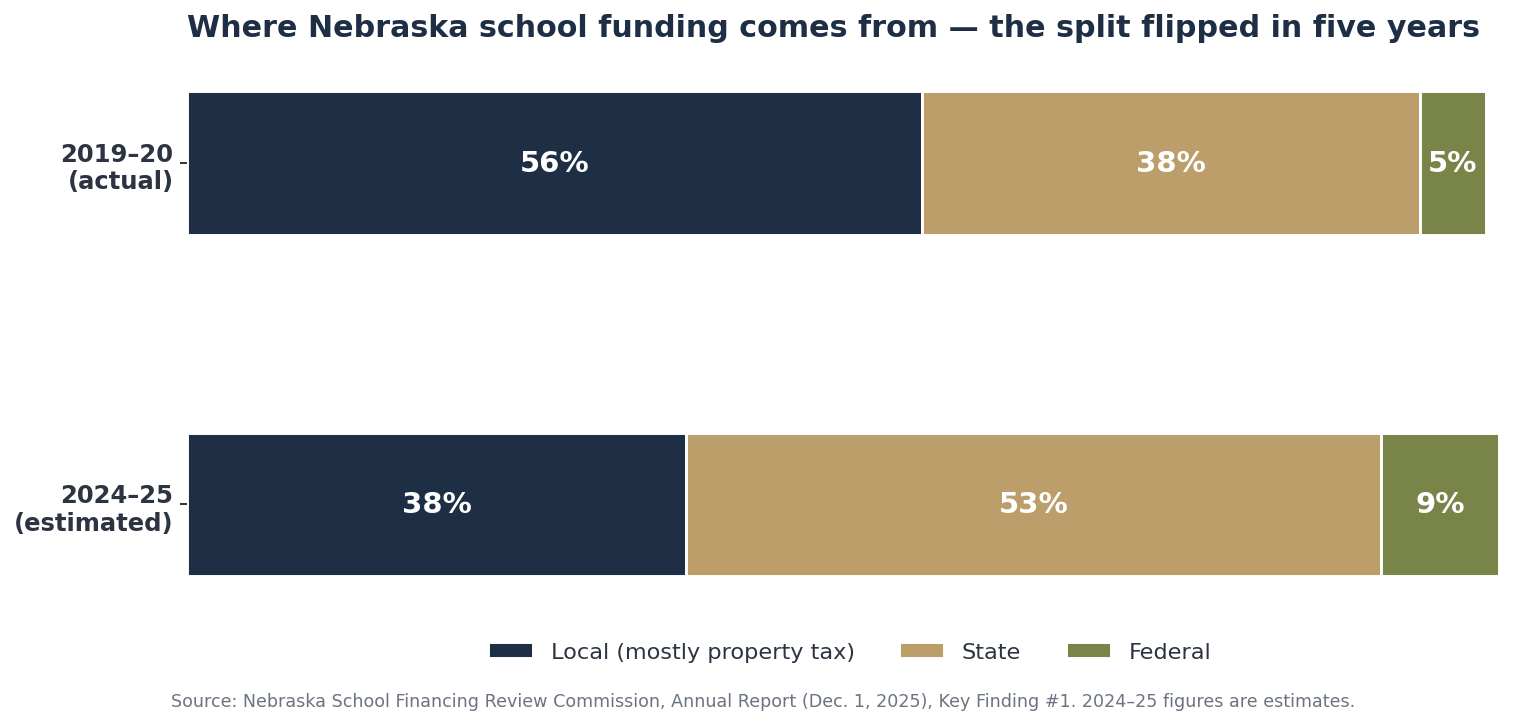
In 2019–20, local sources — overwhelmingly your property taxes — covered 56% of Nebraska school revenue, and the state covered 38%. By the 2024–25 estimates, those numbers had essentially traded places: the state now covers about 53%, and local sources about 38%.
The per-district picture moved just as hard. In 2020–21, 210 of 240 districts got less than 40% of their revenue from the state, and 139 of them got less than 20%. Four years later, 212 of 245 districts sit in the 41–60% range.
Levies came down too. In 2000–01, more than 40% of Nebraska districts levied at or above $1.05 per $100 of valuation. For 2024–25, no district is projected above that line, and most sit below $0.74.
But your levy didn't actually shrink
Here's the part that explains why none of this felt like relief.
A big share of that new "state" money isn't the state funding schools directly. It's the state paying down part of your property tax bill through credits. The Commission spells this out: districts still levy for the full amount, including the property tax credit. Your levy is what it always was. A credit knocks down what you actually hand over.
Which means the flip is partly real and partly an accounting reclassification. Money that used to be counted as "local" is now counted as "state," and the thing it's paying for is the same thing it was always paying for. Nebraska's property tax credits have grown from roughly $100 million in 2007 to about $1.2 billion today, and once you fold all of them in, the highest effective school levy in the state in 2024 was $0.72.
"The state didn't take schools off your property tax bill. It started quietly paying part of the bill for you — and for four years, you had to ask for it."
The relief is real: Nebraskans paid roughly $600 million less in school property taxes levied for 2024 than the year before. It just arrived through a mechanism almost nobody could see.
The credit a lot of people never claimed
This is the part worth ten minutes of your time, because for some homeowners it's still recoverable money.
Back in 2020, LB 1107 created a refundable state income tax credit for the school district portion of your property taxes. It was real money. But it wasn't automatic — you had to file a separate form (Form PTC) with your Nebraska income tax return, the year after you paid the property taxes.
A lot of people never did. By the Department of Revenue's own count, about 45% of Nebraskans weren't claiming it.
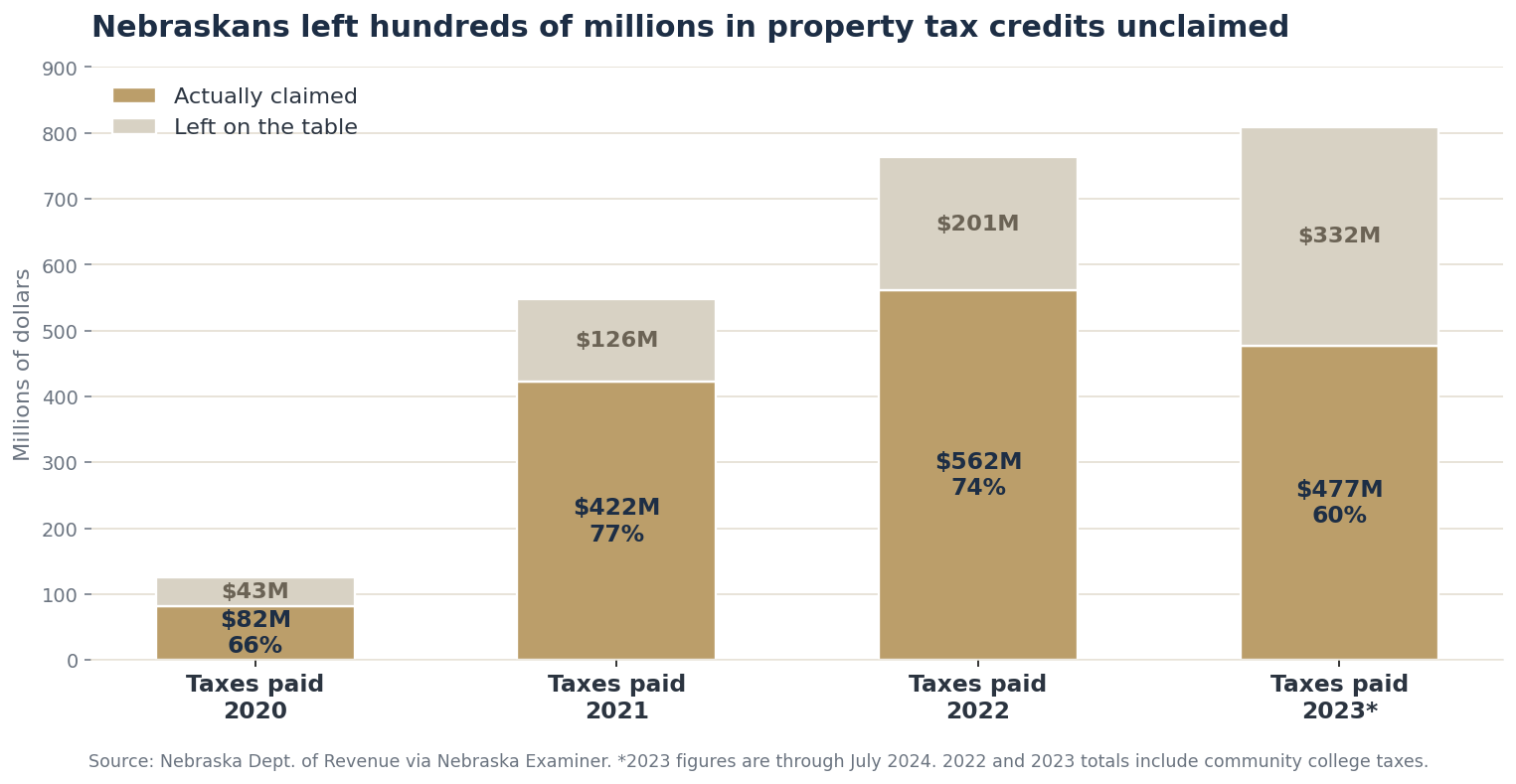
If you were among them, prior years may still be open to you. School district property taxes paid after December 31, 2019 and before January 1, 2024 qualify for the credit, and the state has a form specifically for going back and claiming one you missed — the Amended Nebraska Property Tax Credit, Form PTCX. There's also a free state property tax look-up tool that computes the eligible amount from your parcel number, so you're not digging through old statements with a calculator.
Two things to know before you get excited. Not every dollar on your statement counts — school bonds, voter-approved levy overrides, and educational service unit taxes are excluded. And amended returns have filing deadlines, so how far back you can reach depends on when you filed. That's a question for your accountant, not your Realtor.
One more that comes up constantly in my world: if you bought or sold a house during those years, the credit follows whoever actually paid the county treasurer — not whoever got charged at closing. A buyer who reimbursed the seller for taxes the seller had already remitted can't claim it. Douglas and Sarpy County closings have their own wrinkles here. If you sold a home between 2020 and 2023, it's worth a look.
Free Tool
Compare Property Taxes by Omaha Neighborhood
See the actual levies across the metro — including the SID levies that catch a lot of buyers off guard — and how to appeal your valuation.
Compare Neighborhoods →Why 2024 felt like a year that went missing
In the summer of 2024, the Legislature passed LB 34 in a special session, 40 votes to 3. It did the sensible thing: instead of making you claim the credit a year later, it front-loaded it. A share of your school district taxes — around 30% in the first year — now comes off the property tax statement automatically. The exact percentage is recalculated annually, since it's the year's total pot divided across everyone's school taxes. The first one showed up on statements mailed in December 2024, worth $750 million statewide, and the pot is set to grow by at least 3% a year.
Good change. Automatic beats a form nearly half the state wasn't filing.
The transition, though, left a gap. Taxes assessed in December 2023 — the ones most people paid across 2024 — don't get an income tax credit, because that credit was repealed, and they don't get the front-loaded discount either, because that started with the 2024 assessment. Unless you happened to pay your 2023 statement in full by December 31, 2023, that year has no credit attached to it.
Supporters argued there was no net difference to the taxpayer, since relief still arrives — just at the moment of payment rather than a year later. Opponents called it a retroactive tax increase. That argument is worth having, but the practical takeaway is simpler: if you sat down with your 2024 return and couldn't find the school credit you'd claimed every other year, you weren't losing your mind. It isn't there.
Also still true: the community college portion is not front-loaded. That one you still claim on your income tax return, the old way, on Form PTC.
What happens next
The School Financing Review Commission's first report was findings only — deliberately. It maps what changed and hands the actual policy work to a second phase. That phase produces recommendations, and the report is due November 1, 2026.
The questions it's chewing on are the ones that matter for anyone who owns a house here: what share of school funding should come from the state, how to keep that share from eroding once budgets get tight, and whether the "needs" side of TEEOSA still measures the right things.
If you want the argument about what should change rather than what did, I wrote that separately: why Nebraska property tax relief needs a scalpel, not a sledgehammer.
How to actually show up — and when
People say "go to a school board meeting" like that's useful advice. It isn't, really, because the budget is usually settled by the time it reaches a regular board meeting. Both states have a specific law that creates a specific hearing, and both of them mail you something first. That's the door.
| Nebraska | Iowa | |
|---|---|---|
| The law | Property Tax Request Act, 2021 — "Truth in Taxation" | House File 718, 2023 |
| What arrives in your mail | A postcard marked NOTICE OF PROPOSED TAX INCREASE, showing your estimated tax and the estimated change | A Budget Year Statement from the county auditor, by March 20, listing current and proposed rates |
| The hearing | One countywide joint hearing covering every taxing body — Sept. 17–29, after 6 p.m. | Each body holds its own hearing, noticed 10–20 days ahead, in the spring |
| What's on the agenda | Proposed tax increases only — nothing else allowed | The proposed property tax amount only, separate from other budget business |
| When it's locked in | Levies certified in the fall | Budgets certified by April 30 |
Two things worth knowing about the Nebraska version. It only triggers if a taxing body wants to increase its property tax request by more than 2% plus real growth — so a district that stays under that line doesn't appear, and the absence of a postcard is itself information. And because it's consolidated, you get the school district, the county, the city, and the community college in one room on one night, which is far more efficient than chasing four separate meetings.
Put plainly: it's the one night a year when every entity that taxes your house has to stand up and explain why. And most people throw the postcard away.
Where to look it up: Douglas County Clerk and Sarpy County's budget page post the hearing notice and proposed budgets each year, and in Iowa the Pottawattamie County Auditor handles the March mailing and posts proposed budgets. Dates and locations move year to year, so check the current notice rather than trusting last year's.
The other lever is your own valuation. If it's out of line with comparable homes, Nebraska's protest window is June 1–30 — here's how to appeal a Douglas County valuation. And if you've never read your statement line by line, start there. It takes ten minutes, and it's the only way any of the rest of this becomes concrete.
Do I still need to claim the Nebraska school property tax credit?
No. Starting with property taxes assessed in December 2024, the school district credit is applied automatically as a reduction on your property tax statement — you don't file anything. The community college credit is different: that one still has to be claimed on your Nebraska income tax return using Form PTC.
Can I still claim a credit I missed in an earlier year?
Possibly. School district property taxes paid after December 31, 2019 and before January 1, 2024 qualify, and Nebraska has an Amended Property Tax Credit form (Form PTCX) for claiming one you skipped. How far back you can go depends on filing deadlines for amended returns, so check with your tax preparer. School bonds, voter-approved levy overrides, and educational service unit taxes don't qualify.
Why do some Omaha-area districts get state equalization aid and others don't?
Nebraska's TEEOSA formula pays a district the gap between its calculated needs and its calculated resources. A district with high enough property valuations to cover its own needs gets no equalization aid — in 2024, only 58 of Nebraska's 244 districts qualified. Since 2023, though, every district receives $1,500 per student in foundation aid regardless of equalization status.
When can I speak up about a proposed school tax increase in Nebraska?
Under Nebraska's Truth in Taxation law, any school district, city, county, or community college seeking to raise its property tax request by more than 2% plus real growth must mail affected property owners a postcard marked NOTICE OF PROPOSED TAX INCREASE and appear at a countywide joint public hearing held between September 17 and September 29, after 6 p.m. Proposed tax increases are the only item allowed on that agenda. In Iowa, the equivalent notice comes from your county auditor by March 20, with hearings in the spring and budgets certified by April 30.
If I sold my house, who gets the property tax credit?
Whoever actually paid the county treasurer. If the seller had already remitted the tax before closing, the seller claims the credit even if the buyer reimbursed them on the settlement statement. Douglas and Sarpy County transactions can work differently depending on installment timing, so it's worth confirming against your closing documents.
Questions about what this means for your house?
I'm a Realtor, not a CPA — but I read these statements all day, and I'm happy to help you figure out what you're actually looking at.
Recent Posts