
Omaha vs. Council Bluffs: What You'd Actually Pay
Nebraska has a reputation. Ask around the Omaha metro and you'll hear that the property taxes here are brutal — and honestly, that reputation isn't unearned. So plenty of buyers I work with start eyeing Council Bluffs, figuring they'll dodge the tax bite by crossing the river. Then they pull up an Iowa listing, see a tax rate that looks even scarier, and freeze. So which is it? Let's run the real numbers on what you'd actually pay each side of the river — not the cost-of-living-calculator version, but the one from a Realtor who writes offers in both states every year.
The Short Version
Omaha's brutal property-tax reputation is real — but Iowa's scary-looking tax rate is mostly an illusion, and it actually lands a touch lower. The bigger reason Council Bluffs is cheaper to own is home price, not taxes.
Who should even be looking across the river?
My honest answer: anyone who wants a little more house for the money, as long as the commute works for their life. That's really the whole test. I've helped people move from Iowa into Nebraska, and I've got a client right now weighing a move the other direction, from Omaha into Iowa. It's not a one-way street — it comes down to what you're optimizing for.
And the commute objection is mostly a myth. People picture sitting on a bridge for 45 minutes. In reality the Council Bluffs-to-downtown-Omaha drive is usually 10–25 minutes, and the bridges over the Missouri are basically a non-issue traffic-wise compared to what most transplants are used to in bigger metros.
Are Iowa property taxes really cheaper? Yes — but not how you think
Here's the part everyone gets wrong. Omaha's high-tax reputation is real — but it makes buyers assume Iowa must be the cheap escape, and then the posted Iowa rates scare them right back across the river. If you just compare those posted rates, Iowa looks terrifying. Council Bluffs' combined levy lands around $40 per $1,000 of taxable value once you stack city, county, and school district. Omaha's combined levy is closer to $20 per $1,000. Twice as expensive, right?
No — because Iowa doesn't tax your whole house. Iowa uses a "rollback" that only makes a slice of your home's value taxable. For the current cycle that rollback is 47.43% (it was 44.5% the year before). So on a home assessed at $300,000, Iowa only taxes about $142,000 of it. Nebraska, by contrast, taxes essentially the full market value.
"Never compare Nebraska and Iowa by their posted tax rates. Convert both to what you'd actually pay as a percentage of your home's real value — and the scary Iowa number shrinks fast."
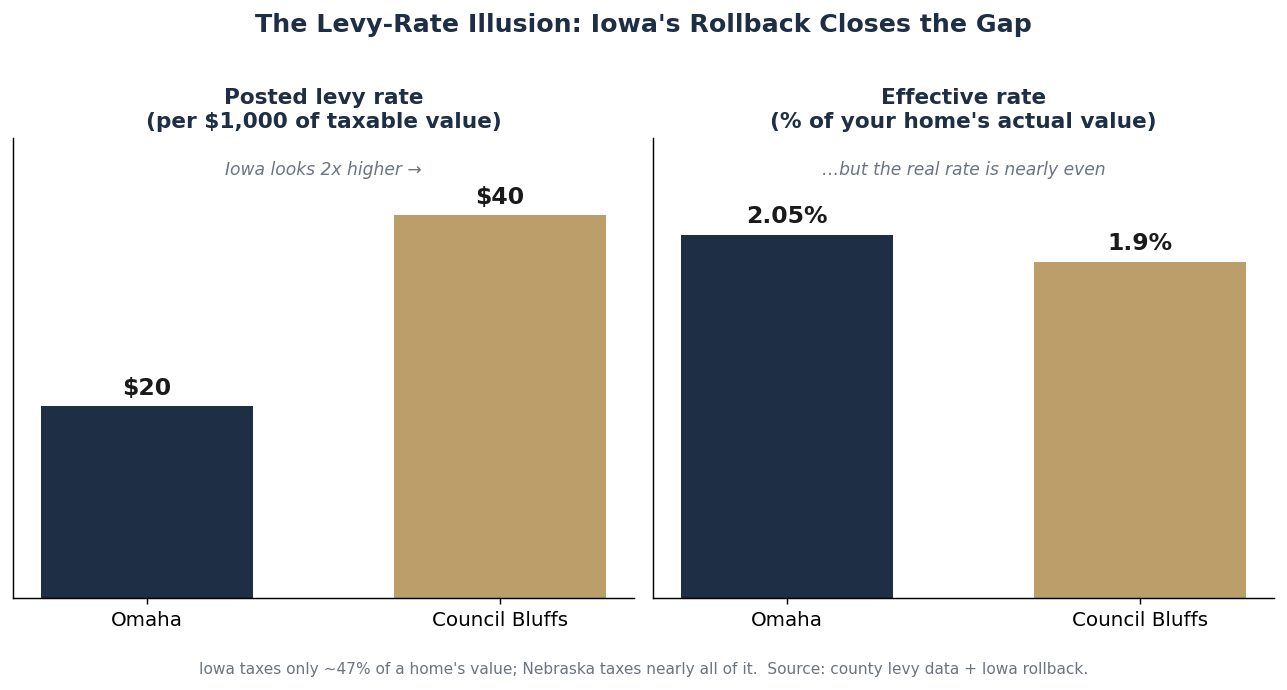
Do that math and the effective rate — what you actually pay against your home's market value — comes out around 1.9% in Council Bluffs and roughly 2.0–2.1% in Omaha. So Iowa does win on taxes, but by a hair, not a landslide. On an equal-priced home you're often talking a few hundred dollars a year, not the thousands the levy rates would suggest. (For the Nebraska side of this, I keep a running breakdown on my Omaha property tax tool.) It's also worth knowing Nebraska now sends back meaningful property-tax credits each year, which trims the Omaha number further.
What you'd actually pay: a $300K home, side by side
Let's make it concrete. Same $300,000 home, two sides of the river, taxes only:
| $300K home | Effective rate | ~Taxes / year | ~Per month |
|---|---|---|---|
| Council Bluffs, IA | ~1.9% | ~$5,700 | ~$475 |
| Omaha — established area | ~2.0% | ~$6,000 | ~$500 |
| Omaha — newer subdivision w/ SID | ~2.3%+ | ~$7,000+ | ~$585+ |
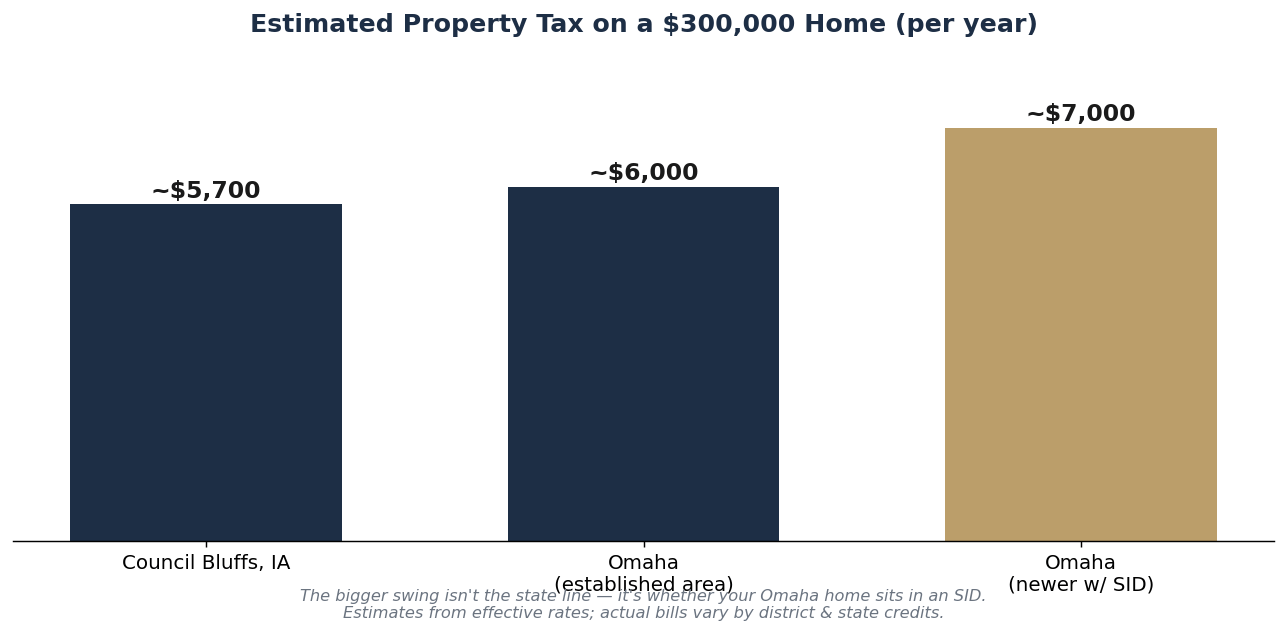
Look at that bottom row. The difference between a Council Bluffs home and a newer Omaha subdivision can be bigger than the difference between the two states — and that's because of something most buyers never see coming on the Nebraska side.
Free Download
Free Omaha Home Buyer's Guide
A practical roadmap through every stage of buying — from pre-approval to closing — with local Omaha and SW Iowa tips you won't find anywhere else.
Download Free →The Omaha wildcard: SIDs
If you're shopping newer construction in Omaha — think the growth edges out in Elkhorn, Gretna, or parts of Papillion — there's a good chance the home sits in an SID (Sanitary and Improvement District). It's how Nebraska funds the streets, sewers, and infrastructure for new subdivisions, and it shows up as an extra levy on your tax bill, sometimes for 15–20 years. It can add anywhere from a few hundred to a few thousand dollars a year on top of your regular taxes.
Council Bluffs simply doesn't have this layer. So when people tell me "Iowa taxes are higher," I'll often pull up an actual newer-Omaha listing and show them the SID line — and suddenly the river looks a lot more appealing. If you're comparing homes, always ask whether an Omaha property is in an SID. I wrote a whole plain-English explainer on how Omaha SID taxes work if you want to go deeper.
Where Iowa actually wins (and where it's a wash)
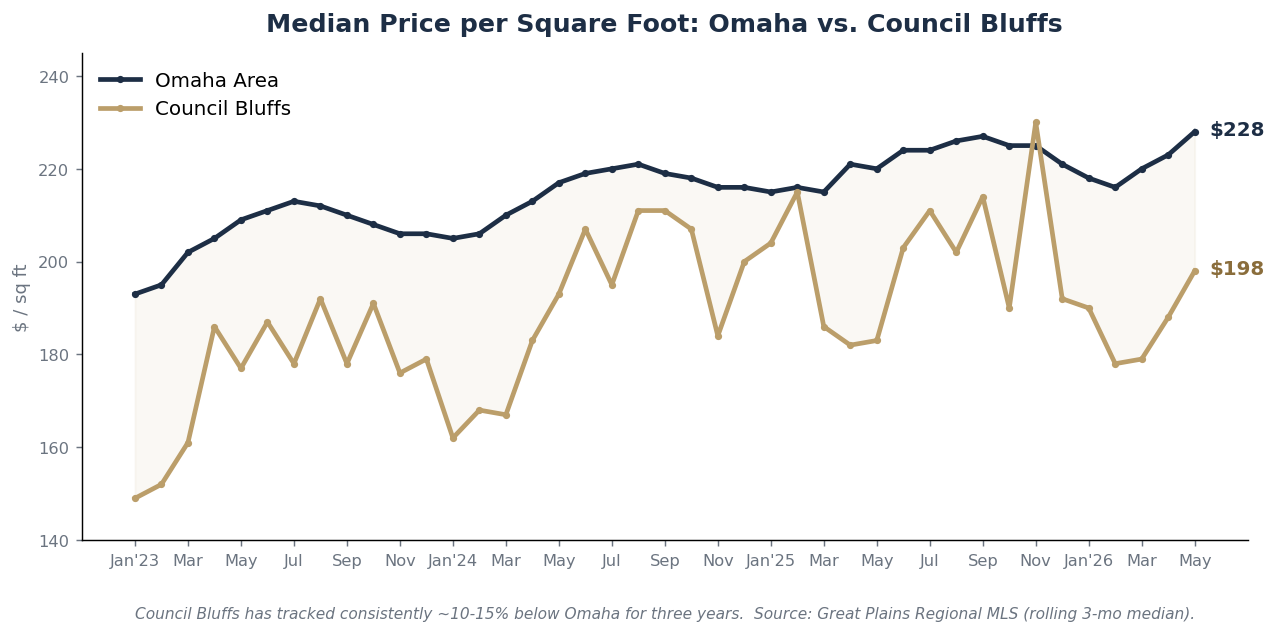
Home price — this is the real savings. Overall cost of living in Council Bluffs runs roughly 9% under Omaha, and housing is the biggest driver. The cleanest way I show this to clients is price per square foot — strip out everything else and just look at what a foot of house actually costs. Right now the Omaha area runs about $228 per square foot, while Council Bluffs sits around $198 — roughly 13% less for every foot of house (Great Plains Regional MLS, mid-2026). That's a real gap that moves your monthly payment: a lower price per foot means a smaller mortgage and a smaller tax base. You can browse active Council Bluffs homes here and compare them against Omaha-area homes under $300K to feel the difference yourself.
Home insurance — call it a wash. From what I see on real quotes, insurance runs about the same on both sides of the river; we're all in the same hail-and-wind part of the country. The one thing to watch in Council Bluffs is whether a specific property sits in a flood zone near the Missouri, which can add flood insurance.
The intangibles. Different state income tax rules, different school districts, different vibe. If schools are driving your search, my Council Bluffs school district guide is a good next read, and the broader Omaha vs. Council Bluffs lifestyle comparison covers the non-money stuff this post skips.
Are property taxes cheaper in Council Bluffs than Omaha?
Slightly. After Iowa's rollback (which taxes under half your home's value), Council Bluffs' effective rate is around 1.9% versus roughly 2.0–2.1% in Omaha. On an equal-priced home that's a modest difference — a few hundred dollars a year — not the huge gap the posted levy rates imply.
Why does Council Bluffs have such a high tax rate?
It only looks high. Iowa posts a high levy per $1,000, but the state's residential rollback only makes about 47% of your home's value taxable, so the rate hits a much smaller base than Nebraska's near-full assessment.
Is it cheaper to live in Council Bluffs or Omaha?
Overall, Council Bluffs runs roughly 9% cheaper than Omaha, mostly on housing. The biggest savings is the home price itself, which lowers both your mortgage and your tax base.
How long is the commute from Council Bluffs to Omaha?
Usually 10–25 minutes from central Council Bluffs to downtown Omaha. The Missouri River bridges rarely cause the kind of traffic that transplants from bigger metros expect.
Not sure which side of the river fits your budget?
I'll run your actual numbers — taxes, SIDs, price — on homes in both states so you can compare apples to apples.
Recent Posts