Why Omaha Isn't Building Starter Homes Anymore
A buyer with $280,000 to spend cannot buy a new house in Omaha. Not a small one, not a plain one, not out on the edge where the land is cheapest. I've gone looking.
In 1960, a buyer in this same metro could get a brand-new two-bedroom house for $9,999. Nine dollars down, ninety-nine a month. A developer platted 335 of them on 80 acres of Sarpy County farmland, and so many families moved in that the place incorporated itself as a city. You know it as La Vista.
I own one of those houses. So this isn't a story about how building affordable homes is impossible here. We did it. At scale. For profit. Then we stopped, and I want to talk about why, and about what it would take to do it again.
Where I'm Coming From
Quick disclosure. I'm a Realtor and I own rental property, so more homes getting built is good for my business. Some of what's below is also an argument my own industry has been making for years — I've sat in those meetings, and that's how I know a few of these examples. Weigh it however you want. I'd rather you know up front.
The wall
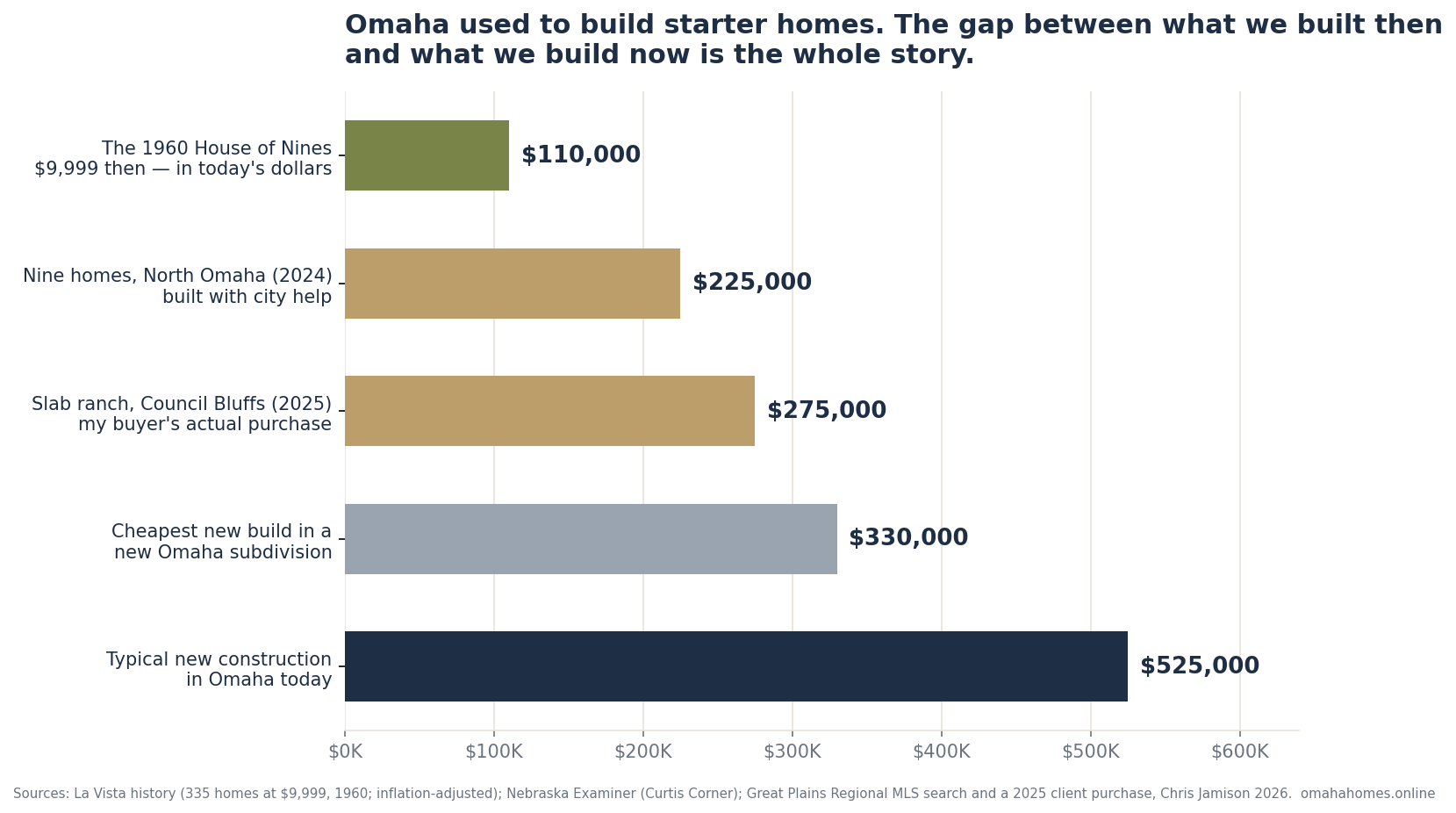
These are my own numbers, pulled from the MLS. Here's where new construction in the metro sits right now:
A few things do pop up below $330,000, and plenty of new construction sells under $500,000. But in a brand-new subdivision, $330K is the practical floor. Below that, the new-construction aisle isn't tight. It's closed.
The City of Omaha ran its own math in a 2025 report to the state and figured a 2,000 square foot house costs about $320,000 to build here. My MLS number was $330,000. Two completely different methods, ten grand apart. That floor is real.
Why builders can't just build a cheaper house
The obvious answer is: fine, build a smaller one. It doesn't work, and the reason is the dirt.
Nationally, the lot runs about 14% of what a new house sells for. Take Omaha's $70,000 minimum lot, work backward from that percentage, and you land right around $510,000 — almost exactly the typical new build here. Our market is behaving completely normally.
Now run it at the bottom. That same $70,000 lot on a $330,000 house is 21% of the price. And a builder can't shrink the lot — the lot costs what it costs. So the only thing left to shrink is the house.
That's why the cheapest new house in Omaha is a ranch with no basement. It's not a builder being cheap, it's arithmetic. Entry-level homes get smaller and more stripped-down rather than cheaper, and past a certain point the builder gives up and puts a $525,000 house on the lot instead, where the money works.
Yes, we have programs. No, they're not going to fix this.
Somebody always brings up workforce housing here, so let's deal with it honestly.
Nebraska does have a program. The state gives matching grants to nonprofit developers, who use the money to build homes for sale. It works. Holy Name Housing, a nonprofit that's been at this on the northeast side since 1983, has built over 200 single-family homes — 17 new ones in 2025 alone. I've walked buyers through them. They're nice houses, there are no income restrictions on who can buy, and right now every home on their for-sale page is marked sold.
Another developer named Phillip McClain built nine three-bedroom houses near 49th and Curtis a couple years back. They appraised around $285,000 and sold for about $225,000, using cheap land, city financing, and nonprofit help to close the gap.
So it can be done in Omaha. Real houses, real families, real prices. Here's the part nobody says out loud.
Look at the addresses. Blondo Street. North 38th Avenue. Camden. John A. Creighton Boulevard. Every home on that Holy Name for-sale page sits in 68111. Curtis Corner is North Omaha. Habitat's Bluestem Prairie is North Omaha. There's some work in Benson too, but it's all clustered in the same handful of older neighborhoods.
That's not an accident and nobody's doing anything wrong. It's written into the rules — for a Douglas County project to use those state dollars, it has to sit inside or next to what's called a qualified census tract. A lower-income area. That's where the money is legally allowed to go, so that's where the houses get built.
And that's fine. The program is doing the exact job it was designed to do, in the places it was designed to do it, and doing it well. But it was never designed to be the answer for the whole metro, and we shouldn't pretend it is.
The buyer getting priced out right now isn't only shopping North Omaha. She's looking in Millard and Papillion and Bellevue and Elkhorn, near her job and the schools she wants, and there is nothing being built for her anywhere at a price she can reach. Meanwhile the nonprofits are producing a few dozen homes a year against a city that needs somewhere north of 3,700 new units annually and has cracked 3,000 only twice in a decade.
These organizations have proven the thing is possible. Nobody has built the version that runs at the size of the actual problem.
And before you assume Washington has this covered — somebody will bring up the Neighborhood Homes Investment Act, a bipartisan bill in Congress that would cover up to 40% of the cost of building a new home for sale. That's refreshing, since nearly every housing program we have is built around rentals. I checked whether it would help a builder in Papillion or Elkhorn. It wouldn't. Same as the state program, it only applies in lower-income census tracts. Worth passing, and it still wouldn't touch the suburbs.
That's the hole in all of this. Not that nobody's trying — that everybody who's trying is aiming at the same few zip codes.
Two more things while we're here, because both get sold as progress.
This July the state raised the ceiling on what counts as workforce housing from $330,000 to $375,000, and indexed it to inflation going forward. That doesn't make a single house cheaper. It just lets a subsidized house be more expensive and still qualify. The number was never holding prices down — it only decided what counted.
And if you sold a house after July 18, the state's transfer tax went up a dollar per $1,000 of sale price — about $350 on a $350,000 house — with the money earmarked for these same funds. Half of it goes to a fund restricted to counties under 100,000 people, which by law rules out Douglas and Sarpy. The other half comes back here, but only inside those census tracts, and only nonprofits can apply. A private builder who wants to put up affordable starter homes with his own money can't touch it. I didn't think that tax should have passed, and neither did my industry's association.
Worth knowing where all this money actually stands, too. The Legislature hasn't committed new dollars to the housing funds since 2022. Last year budget writers wanted to cut $4 million from each of them, and the compromise was raiding $8 million out of the Affordable Housing Trust Fund instead — which, unlike the others, is the one funded by your transfer tax at closing. The state is back in a projected deficit. A housing policy director quoted in the Nebraska Examiner summed it up in four words: "It's all at risk."
Omaha legalized some fixes. Almost nobody used them.
In March 2024 the city legalized backyard cottages — the small second home some people call a mother-in-law suite — across about 85% of Omaha's land. Not a pilot. The city even put eight free pre-approved designs online.
In all of 2024, Omaha approved nine of them.
The math explains it. One of the nonprofits working on this says a backyard cottage here runs $100,000 to $200,000 to build, and city code says you can never sell it separately from your main house. So what you're really building is a rental property in your own backyard, and giving up your yard to do it. For that same money you could buy a small existing house somewhere else in Omaha and rent that out instead — separate title, sell it whenever you want, keep your yard. That's what I'd tell most clients to do.
Omaha also has two other affordable-housing incentives on the books, one since 2007, that according to the city's own report have never been used a single time. I couldn't find an explanation for those anywhere, and I looked.
I'm not arguing the city is blocking housing — I don't think that's what's happening. The tools exist, the city put them there on purpose, and it's handed over land for a dollar to get houses built. They just sit in the drawer, because making something legal and making it pencil out are two different jobs. Same with permits, by the way: Omaha hasn't raised residential building permit fees since 2010, while the typical home in the city gained about 90% in value. Whatever's driving costs here, it isn't the permit counter.
Free Download
Free Omaha Home Buyer's Guide
If new construction is out of reach, the existing-home market is where you'll actually find something. Here's the roadmap — pre-approval to closing, with local Omaha specifics.
Download Free →So what would actually work?
Tinkering with the existing programs won't get us there. What's missing is something big enough and open enough that a production builder looks at it and decides to go all in. Some of that has to come from Washington. Plenty of it doesn't.
Go get the cheap land
You can't design your way around $70,000 of dirt, but you can find dirt that doesn't cost $70,000. When the Omaha Land Bank cleaned up and prepped its first batch of vacant lots, they sold for $14,200 to $33,900 — a third to a half of a subdivision lot on the edge of town. The city has been handing some over for a dollar. Biggest, cheapest lever we've got.
Here's the other half of it, and it's the piece I've never heard anybody talk about. Right now, a farmer sitting on ground at the edge of the metro is looking at a huge capital gains bill if he sells. That tax is a real reason land doesn't come to market — it's often cheaper to keep farming it than to sell and hand a third of the gain to the IRS.
Congress actually addressed this last year. Farmers can now spread the capital gains from a farmland sale over four years instead of eating it all at once. But the break only applies if the buyer keeps farming the land for the next ten years. Sell to a homebuilder and you get nothing.
So the one tax incentive we've built for farmland sales specifically pushes that ground away from housing. Flip it. Offer a farmer the same deferral — or a straight tax holiday — on ground sold for starter-home development, with strings attached on price point so it can't just become another subdivision of $600,000 houses. You'd move land into the hands of builders without the government buying a single acre.
I'm a Realtor, not a tax attorney, so somebody smarter than me should draft the details. But the mechanism already exists. It's just pointed the wrong direction.
And there's a free version of this the city has quietly started allowing: splitting a corner lot into two. Each half gets its own frontage and address, and you've created a buildable lot out of thin air with the streets and sewer already in. That's how the two Benson houses I mentioned got their sites. The city's urban design manager makes the point that this used to be ordinary here — plenty of older Omaha neighborhoods are full of it, from back before modern zoning made it hard. Every corner lot in this city is a potential extra house, at no cost to anybody.
Stop pretending factory-built homes aren't real homes
This is the one nobody wants to hear, and I think it matters most.
A factory-built home runs about $60 to $140 a square foot installed — roughly 40 to 50% less per square foot than building the same house on site. Modular homes, built in sections at a factory and assembled on a permanent foundation, land around $80 to $160 a foot. Read that against the $330,000 floor.
What people think they know about these is out of date, and the real issue is narrower than "factory homes are cheap junk." It comes down to the foundation. Set one on blocks and it stays titled like a vehicle — that's where the short terms, high rates, and resale headaches come from. Put the same house on a permanent foundation, titled as real property, and it's a house. Conventional, FHA, VA, normal appraisal. Modular clears that bar automatically, because it's built to the same code as a site-built home.
I went looking for whether any metro city bans these, and the answer surprised me. They can't. Nebraska law flatly prohibits a city from refusing a home for the sole reason that it was factory built, as long as it carries the right certification seal. A city can hold it to the same foundation, utility, setback, and square footage rules as any other house — which a modular home meets anyway.
So the barrier isn't city hall. It's private subdivision covenants, which state law doesn't touch. It's lenders and appraisers who see fewer of these. And it's a reputation earned decades ago by homes that were never set on foundations in the first place.
And there's no shortage of companies doing this. Several modular builders already serve the Omaha market — some national, some regional, and one right here in Nebraska: Heritage Homes has been building on permanent foundations out of Wayne since 1978. Ranches, two-stories, cape cods. You'd drive past one and never guess.
Here's what convinced me this isn't theoretical. Remember that Holy Name house on Camden Avenue I mentioned? Construction students at Metropolitan Community College built it in four modules on the Fort Omaha campus, trucked it a half-dozen blocks, and set it on a narrow lot. Four bedrooms. It went up for under $275,000, with the basement finished and a garage on the table. That was their second one, and the students had done four similar projects before it.
Then there's a project called OurStory, where UNL architecture students prefabricate components in Lincoln and Holy Name assembles them in Benson. Two houses: a two-bedroom listed at $190,000 and a one-bedroom at $150,000, aimed at exactly the two groups I keep talking about — people downsizing and people buying their first place.
So factory-built affordable housing in Omaha isn't a proposal. It's already been done, at prices well under anything the open market produces. It's just been done about six times, by students, as a teaching exercise.
That's not a knock on any of it — those are good houses and the training is worth something on its own. Holy Name's director points out that the construction trades are badly understaffed, and that labor shortage is a real piece of why building costs what it costs. Teaching kids the trades while producing a $190,000 house is a genuinely smart trade.
But it does tell you the model works here. What I honestly don't know is whether anyone could run it at volume — a whole subdivision's worth in a year or two, rather than a couple of houses a semester. That's a fair question to put to the modular builders, and it's a solvable business problem. Which is more than you can say for $70,000 lots.
What about 3D-printed houses?
People keep asking. Short version: promising, not ready. The biggest company in the space claims 10 to 30% savings; a competitor is blunter, saying their homes currently cost about the same as a standard lumber build and they're hoping that changes at scale. Finished houses run $175,000 to $350,000. Ask me again in five years.
One idea I'd pass on
People will point you toward community land trusts, where a nonprofit permanently owns the land and you buy only the house, leasing the ground underneath. It drops the price a lot. There isn't one in Nebraska.
I'm not sold, and it's because of what I've watched with leased-land property here. We have versions of this around some of the lakes and rivers — you own the cabin, somebody else owns the ground. Those deals are a headache. Financing is harder, fewer lenders touch them, appraisals get strange, and your buyer pool shrinks when you sell. You've made the house cheaper to get into and harder to get out of.
Open it up — everywhere, to anybody who builds the house
This is the big one, and it's two changes.
Let a private builder get the same help a nonprofit gets. If somebody puts up a $250,000 house for a family earning a normal wage, that's the same house no matter who built it. Right now the money is closed to them, and that isn't a small detail — it's most of the homebuilding industry, locked out by definition.
And stop drawing a circle around a few zip codes. As long as the dollars can only land inside certain census tracts, that's the only place the houses go up, no matter where the shortage actually is. A teacher priced out of Millard doesn't get helped by a program that can only build in North Omaha.
Put those two together and you'd have something a production builder could look at and say: I can run that. Not a nonprofit doing fourteen houses a year, admirably. A builder doing four hundred, because the math finally works.
What I'd actually build
Let me get specific, because "we need affordable housing" is easy to say and useless.
My rental — one of the original Nines — is a two bedroom, one bath. The laundry was in the kitchen. No garage. No basement, just a crawlspace. As far as I know every one of them was built that way. I've since added a half bath and moved the laundry to the hallway, so mine's a 2 bed, 1.5 bath now.
They stripped cost out anywhere they could. My understanding is that buyers could even paint the house themselves and knock something off the price — I've never seen that in writing, so take it as neighborhood lore, but it fits everything else about how these were built.
Sixty-five years later it's still standing and still perfectly good shelter for somebody. But nobody's going to line up for that exact house today, and they shouldn't have to.
Drive through that neighborhood now and you can watch what families did with them. Somebody added an attached garage. Somebody else built a detached one out back. There are additions off the rear, dormers, enclosed porches, every kind of update sixty-five years will produce. And underneath all of it you can still see it — every single one of these houses was once the exact same house.
That's the part worth sitting with. The standardization wasn't a compromise the buyers resented. It was the thing that got them in the door, and then they made it theirs over the next several decades. Nobody drives through there today and sees cookie-cutter houses. They see a neighborhood.
| The 1960 House of Nines | What would sell today | |
|---|---|---|
| Bedrooms | 2 — every one of them | 3 |
| Bathrooms | 1 | 2 full |
| Laundry | In the kitchen | Its own space |
| Basement | None — crawlspace | Yes. Split entry gets you one cheap |
| Garage | None | Attached |
| Price | $9,999 — $9 down, $99/month | The whole question |
Build that house — three bedrooms, two full baths, a basement, an attached garage — and it sells all day long in this market. Every day. I could take buyers to a subdivision of those tomorrow and they'd be gone before the drywall was up.
And I don't think it needs inventing. A modular builder with three or four floorplans, repeating them, could hit that spec and hold the cost down.
Split entry is the piece that makes the math work, and here's the thing — you already know what one looks like. Drive any starter-home neighborhood in Omaha and they're everywhere. What most people never think about is why there are so many of them. Builders weren't chasing a look. A split entry is the cheapest way ever devised to get a family a basement: you set the house partway into the ground, and the lower level costs a fraction of what the same square footage costs above grade. That's where your third bedroom and second bathroom come from without paying for more foundation, more roof, or more lot.
They came out of exactly this problem the last time we had it. The reason so many of them are in the starter price range today is that they were built as starter homes, by people trying to solve the same equation.
And I'd build a second plan aimed at the other end. A ranch on a slab — no basement, no stairs — with a storm shelter built in somewhere. That house sells all day long to downsizers, and right now almost nobody builds it. People assume you can't sell a Nebraska house without a basement, but what they actually want is somewhere to go when the sirens start. Give them that and the objection disappears. I had a buyer purchase something along those lines in Council Bluffs last year for $275,000, and it was exactly right for them.
Two plans, then. One for the family starting out, one for the couple getting out from under stairs and a yard. Both boring on purpose. Both repeated until the crews can build them in their sleep.
Here's the other thing that makes this work: it doesn't have to be a cornfield. Get the process down and the same house goes up on a scattered infill lot in the city just as well as in a new subdivision out west. Omaha has plenty of empty lots, they're cheaper than greenfield, and the streets and sewer are already in. A builder running standardized plans can work both — take the subdivision when there's land, take the infill lots when there isn't. That's how you keep the crews busy and the price down without being at the mercy of one land deal.
"One builder, one price, 335 houses. It didn't just create a neighborhood, it created a city. I own one of them."
The piece that still needs help is the land, and that's where I'd put the public money. Not into a program that picks winners by census tract — into the dirt. Repurpose government-owned land, or buy land and write down the cost, and hand a builder a run of lots at a number that makes a $250,000 house pencil. Scattered infill lots count just as much as a subdivision here.
That's what Don Decker had in 1959 that nobody has now: cheap ground, a standardized product, and a price he could put on a sign. Adjusted for inflation, his $9,999 house would be about $110,000 today — a third of the cheapest thing we currently know how to build.
Nobody's getting back to $110,000. But $250,000 with a garage and a basement? That's not a fantasy. It's a floor plan, a factory, and a lot that doesn't cost seventy grand.
We're talking about the kind of house a teacher or a nurse buys and stays in for fifteen years. Somebody built 335 of them here and started a city doing it. I'd like to figure out how to make that make sense again.
Can I still buy new construction in Omaha under $300,000?
Rarely, and almost never in a new subdivision. Occasionally something comes up on an infill lot in an older neighborhood. If your budget is under $300,000, the existing-home market is where you'll find real options — and there are good ones.
Why don't builders just build smaller, cheaper houses?
Because the lot is a fixed cost. At $70,000 minimum, land is about 21% of a $330,000 house versus roughly 14% nationally. Shrinking the house doesn't shrink the lot, so entry-level homes end up smaller rather than meaningfully cheaper — and eventually builders move upmarket where the math works.
Is a factory-built home a bad investment?
What matters is the foundation. On a permanent foundation and titled as real property, a factory-built home finances and appraises like any other house — conventional, FHA or VA. Set on blocks, it's titled more like a vehicle, and that's where the higher rates and resale problems come from. Modular homes are built to the same code as site-built and clear that bar by default.
Can a city in the Omaha metro refuse to allow a modular home?
Not for being factory built — Nebraska law prohibits that, as long as the home carries the proper certification seal. A city can require the same foundation, utility connections, setbacks and minimum square footage it would require of any house on that lot. Watch the private subdivision covenants instead; those aren't covered by the statute and can restrict them.
If I buy a below-market home in a TIF project, what happens to my property taxes?
Your taxes follow the county's assessed value, not what you paid — so buying a home for $225,000 that assessed at $285,000 doesn't automatically get you a $225,000 tax basis. In Douglas County you may also receive two statements from the Treasurer on a TIF property, one for the base value and one for the increase, with the increase repaying the project's construction loan for up to 15 years. Nothing shady about it, but budget your escrow off the assessed value.
Can you sell a house in Nebraska without a basement?
Yes — especially to downsizers, who often want to be off stairs entirely. The real objection isn't the basement, it's having somewhere to go in a storm. A slab ranch with a built-in shelter answers that, and it's a meaningfully cheaper house to build. I had a buyer purchase one along those lines in Council Bluffs last year for $275,000.
How much did the transfer tax go up, and what does it cost me?
It rose a dollar per $1,000 of sale price on July 18, 2026 — about $350 more on a $350,000 sale. The seller pays it, and it's set to drop back to the old rate in 2032.
Trying to buy in this market?
Tell me your budget and I'll tell you honestly what it buys in Omaha right now — new, existing, or somewhere in between.
Sources: City of Omaha 2025 Affordable Housing Report, filed with the Nebraska Legislature; Nebraska Legislature LB 1067, LB 866 and LB 768; Nebraska Department of Economic Development; Neb. Rev. Stat. §§ 14-402 and 19-902 (cities may not bar a home solely for being factory built); City of Omaha and Douglas County Treasurer on tax increment financing; Holy Name Housing Corporation; Metropolitan Community College's student-built modular homes with Holy Name; the OurStory project (UNL College of Architecture, Partners for Livable Omaha and Holy Name); Nebraska Examiner and The Reader reporting on Omaha housing, state housing-fund budgets and the Omaha Municipal Land Bank; Neighborhood Homes Investment Act (H.R. 2854); published 2026 cost ranges for manufactured, modular and 3D-printed construction; La Vista city history on the House of Nines; new construction pricing from my own MLS search. More reading: property tax relief that would actually work, how Nebraska funds its schools, and what an SID tax actually is.
Recent Posts