Nebraska Property Tax Relief Needs a Scalpel, Not a Sledgehammer
A note before I start: this one's an opinion piece. These are my views as an Omaha homeowner and an independent voter, not my brokerage's. I should also tell you I'm a Realtor and I own rental property, which means I have money riding on some of what follows. You can weigh that however you want — I'd rather you know it than find out later.
I went to a panel on property taxes at the end of July, read the op-ed everybody's passing around, and came away thinking the same thing I always think about this issue: almost everyone is right about the problem and wrong about the fix.
The problem is real. Nebraska homeowners pay too much. But most of the proposals I hear are sledgehammers, and sledgehammers in tax policy have a bad habit of landing on the people you were trying to protect.
Where we actually rank, and why
Nebraska has the fourth-highest effective property tax rate in the country — 1.38%, according to Construction Coverage's analysis of 2024 Census data. On a $400,000 house that's $5,516 a year. The national average is $3,552.
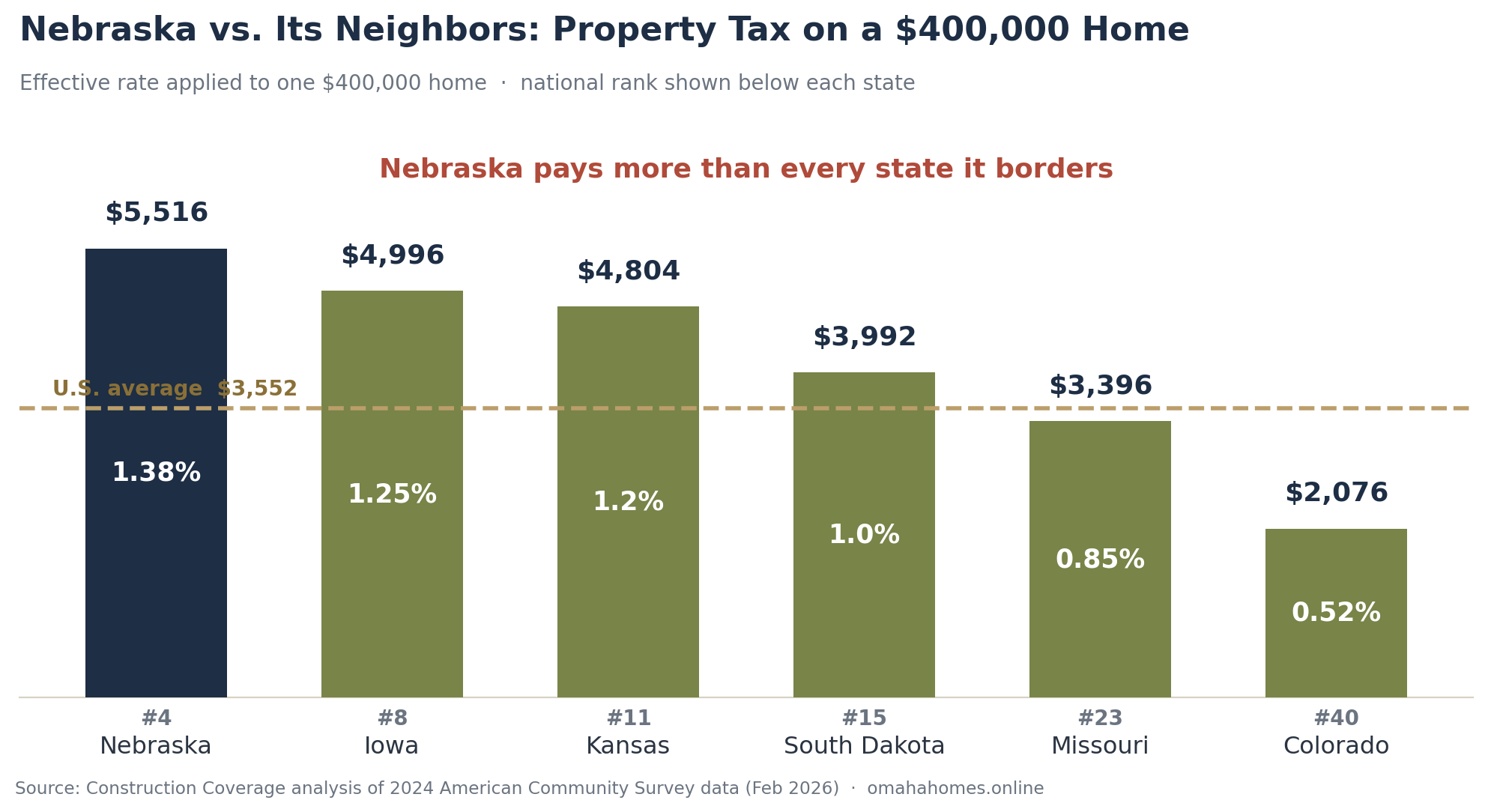
Here's the part that's hard to argue with: Nebraska pays more than every single state it borders. All six of them. Iowa, Kansas, South Dakota, Missouri, Colorado, Wyoming — not one of them is more expensive than we are.
Iowa and Kansas are the closest comparisons we've got. Same economy, same crops, same kind of towns, and in Iowa's case close enough that plenty of my clients weigh Omaha against Council Bluffs on the same afternoon. Iowa comes in at $4,996 on that $400,000 house, Kansas at $4,804. Both cheaper than us. South Dakota is arguably our nearest twin — rural, agricultural, small population, same politics — and pays $1,524 less every year. Missouri's owner pays $2,120 less.
Nobody can wave this away with "well, they've got something we don't." Iowa doesn't have a special economy. South Dakota isn't sitting on a windfall. These are our peers, and we're the expensive one.
So what are they doing that we aren't? The answer is boring and it's almost the entire story: we fund schools with property taxes and they don't, at least not to the same degree.
Nebraska built one of the most locally funded school systems in the country. As recently as 2021–22, local sources covered roughly 58% of school revenue here while the state covered about 30% — among the lowest state shares in the whole group of states we'd naturally compare ourselves to. And under Nebraska's equalization formula, most districts get nothing: in 2024, only 58 of the state's 244 districts qualified for equalization aid. The rest were running on their own tax base, which mostly means your house.
"Iowa and Kansas aren't smarter than we are. They made a different choice about who pays for schools — and that choice is what shows up in your mailbox."
Leaning that hard on local funding means almost everybody else covered more of that cost at the state level than we did, including every neighbor on that chart. Same schools to pay for. Different pocket. Ours happens to be the one attached to your house.
That's a decision, made and re-made over decades. Everything else in this debate is downstream of it.
Worth saying for balance, and this is a bigger caveat than it sounds: a lot of that has changed in the last three years. LB 583 in 2023 gave every district $1,500 per student in foundation aid and roughly doubled the state's share of special education costs. LB 34 in 2024 then took a credit that used to sit on your income tax return and moved it straight onto your property tax statement. By the state's own accounting, the balance has flipped — state sources now cover about 53% of school revenue and local sources about 38%, close to the mirror image of where we sat in 2019–20.
Here's the catch, and it's why your bill doesn't feel fifteen points better. Districts still levy for the full amount. The credit reduces what you hand over, not what gets levied against your house. So a good share of that new "state" money is really the state paying part of your property tax bill on your behalf. The relief is genuine — Nebraskans paid roughly $600 million less in school property taxes for 2024 than the year before — but it arrives as a discount on a structure nobody actually changed. Which is the whole reason I'm writing this: we keep buying down the symptom.
Here's the part that makes this hard
That arrangement bought us something, and I don't think we should pretend otherwise.
I work with relocating buyers constantly — people moving here from Chicago, Dallas, Kansas City, both coasts. The schools come up in almost every one of those conversations, and it's not a complaint. It's usually surprise. They expected to trade school quality for affordability and they didn't have to. That's a real asset, and a meaningful chunk of why families choose this metro over cheaper places.
And the numbers back it up. Nebraska usually lands in the top ten nationally in education rankings, with a graduation rate around 90% against a national average closer to 86% — and we do it on roughly $10,500 per pupil against a national benchmark near $13,000. Above-average results, below-average spending. Whatever else is broken here, this isn't a system torching money.
We paid for that directly, out of our own houses, every year. So when someone says the answer is simply to cut school spending, I'd push back — not because school budgets deserve no scrutiny, but because most Nebraskans, asked plainly, would not trade what we have for a few hundred dollars a year.
The obvious response is "fine, move it to the state." That's not free either, and California already ran the experiment: after Prop 13 pushed school funding to Sacramento, the state fell from 5th in the nation in per-pupil funding to 47th within two decades. Changing who writes the check changed the size of the check. There's a better version — Michigan's, which named its replacement revenue before cutting the old one — but it's a hard problem with real tradeoffs on both sides, and it deserves more room than I can give it here. I broke the whole question down separately: how Nebraska funds its schools, and what it costs you.
"We didn't get overcharged. We made a trade. The question is whether we can keep the thing we bought and change how we pay for it."
Which leaves exactly one honest path: shift more of the cost off of property and onto something else, without cutting what the schools get. That's what the School Financing Review Commission has been examining since 2025. It's the right fix. It's also a legislative fight that would likely need a constitutional change, and it is not happening in time to help anybody's next tax bill.
So there are two questions, not one. The long one is how we restructure school funding. The short one — the one that actually affects the people getting squeezed right now — is what relief we can deliver in the meantime, and how we deliver it without making things worse. The rest of this is about that second question.
Free Tool
Compare Property Taxes by Omaha Neighborhood
See the actual levies across the metro — including SID levies that catch a lot of buyers off guard — and how to appeal your valuation.
Compare Neighborhoods →Why the popular fixes backfire
A hard valuation cap sounds great until you meet California. Proposition 13 caps assessment growth at 2% a year until a property sells. Sounds like protection. What it actually built is a two-tier system: an Irvine homeowner who bought in 1995 pays around $4,000 a year, while the neighbor in the identical floor plan who bought in 2024 pays about $11,000. Same house, same street, nearly triple the tax. Economists have documented the lock-in effect it creates — people stay in homes they've outgrown because moving triggers a reassessment they can't afford.
And you don't have to imagine what lock-in does to a market, because we're sitting in one right now for a different reason. Half the metro is holding a 3% mortgage. Those people aren't moving — not because they don't want to, but because trading a 3% note for a current-market rate is a raise they'd have to give themselves. So they stay. Listings stay off the market. Inventory stays thin, and the houses that do sell get bid up by everyone who couldn't buy the ones that never came available.
Different cause, identical result: a financial penalty for moving, and a market where people are frozen in place. Now imagine baking that into the tax code permanently, on top of what we've already got. I sell houses to first-time buyers and move-up families. A Prop 13 system would hand my past clients a windfall and charge my next clients for it. I'm not for that.
Taxing out-of-state owners hits a wall, and we've already tested it. I like this idea instinctively. There's a lot of Nebraska ground owned by people who've never set foot on it. But in 1982 Nebraska voters passed Initiative 300, a constitutional amendment restricting corporate and outside ownership of farm and ranch land, and in 2006 the Eighth Circuit struck it down as a violation of the Commerce Clause. The Supreme Court declined to hear the appeal. We ran this experiment and lost.
There's a bigger problem than the legal one, though. Most rented Nebraska farm ground is owned by people who aren't corporations at all — retired farmers, widows, heirs. Grandma moved to Lincoln, still owns the quarter section, cash-rents it to a neighbor. Raise her taxes and the cash rent goes up. The family farmer you were protecting is the tenant, and the tenant pays it.
I know this because it's the same math on my rental houses. Raise the tax and it lands on the renter. That's not a reason to never tax anything — it's a reason to be careful where you aim.
Notice what those two failures have in common, because it's the most useful thing in this whole piece. Both of them sort people by category — long-time owner versus new buyer, in-state versus out-of-state. And categories are lousy proxies for what you actually care about. "Out-of-state landowner" sounds like a hedge fund and turns out to be a widow in Sun City. "Homeowner who's been here a while" sounds like someone who needs protecting and turns out to be the person with the most equity in the county.
Every time we reach for a category, we catch our neighbors along with our targets. Then the whole thing collapses into an argument about whether landlords are villains or seniors are freeloaders, and nothing passes.
The federal government just showed us how to do this right
On July 11, 2026, the 21st Century ROAD to Housing Act became law. Buried in it is a ban on large institutional investors buying single-family homes — defined as entities controlling 350 or more houses.
Look at what that design does. It doesn't ban investors. It doesn't ban corporations. It doesn't ban landlords, which means it doesn't touch me or the guy down the street with a duplex. It picks a number, and everything under the number is left alone. It passed the Senate 89 to 10 and the House 358 to 32 — margins you basically never see anymore.
That's the lesson. Threshold beats category. When you write a rule by category — corporations, out-of-state owners, landlords — you sweep up your neighbors along with your targets, and you hand the other side an easy argument. When you write it by scale, you can say plainly: below this line nothing changes for you, above it, it does.
Apply that thinking to property taxes and the picture gets a lot clearer.
Four things I'd actually do
Each of these draws its line by size or by circumstance, not by what group you belong to. That's the test I'd apply to any property tax proposal before taking it seriously.
1. Fix the homestead exemption cliff
This is the cheapest, most obvious win on the board, and it's my number one.
Nebraska's homestead exemption phases out in ten-point steps. For a single filer over 65, each step is about $1,900 of income. Cross one line and you lose 10% of your exemption — real money, roughly $200 a year in Douglas County. The whole phase-out spans just $17,300.
Here's what that means in practice. A 66-year-old widow living on $36,000 has her full exemption. She takes a part-time job at the garden center for twenty hours a week — partly for the money, mostly to be around people. That job pays $20,000. She's now at $56,000 and her exemption is zero. We built a system that financially punishes an older person for staying active.
Four fixes, none of them expensive: smooth the phase-out so no single dollar of income costs $200. Index the brackets to inflation, because right now they quietly shrink every year. Exempt the first $15,000 or so of earned income for seniors so part-time work doesn't disqualify anyone. And let people on fixed Social Security recertify every three years instead of annually — their income isn't changing, and the annual paperwork is how folks lose the exemption by accident.
That last one isn't hypothetical. Nebraska already does it for certain veterans: those with a 100% permanent service-connected or Individual Unemployability rating file their certification in years ending in 0 or 5 rather than annually, and paraplegic or multiple-amputee veterans in a VA-contributed home don't renew at all once approved. The mechanism exists. We built it, decided it made sense, and then left everyone else filing paperwork every February.
And the Legislature is already in here. LB 425, in the current session, changes homestead provisions for certain disabled veterans and surviving spouses. So this isn't a matter of prying open a door nobody's willing to touch — the door is open and senators are actively working on the other side of it. Widening the fix to reach seniors on the income cliff is an amendment, not a revolution.
2. A valuation cap that stops shocks without building a two-tier system
I said above that Prop 13 is the wrong model. That doesn't mean no cap. It means the cap has to be set where it catches genuine shocks and nowhere else.
Nobody should absorb a 40% valuation jump in a single year. That's not a market signal, that's a household emergency, and it hits hardest exactly where you'd expect — a neighborhood that's suddenly desirable, full of people who bought when it wasn't. A cap somewhere in the 10 to 12% range absorbs that without doing what California did, because normal appreciation almost never exceeds it. Your bill still tracks the market over time. You just don't get one year that takes you out.
The difference between this and Prop 13 is entirely in where the number sits. Two percent is so far below normal appreciation that a permanent gap opens between neighbors and compounds forever. Ten to twelve is above it, so the cap only ever engages in the abnormal year it was built for. Same mechanism, opposite result.
3. Agricultural land by acreage, not by address
Nebraska assesses ag land at 75% of market value while your house is assessed at 100%. Rather than stripping that break based on where an owner lives — which we already know doesn't survive court — tier it by size. Keep the 75% on the first tranche of acres and step toward full valuation above it. The family operation keeps the protection. The consolidated twenty-thousand-acre operation doesn't. Nothing depends on the owner's zip code, so there's no constitutional problem.
4. Open TIF up to the people building starter homes
Tax increment financing lets a developer capture the increase in property value their project creates, for up to fifteen years. In Omaha the city refunds those taxes to the developer annually until the deal is paid off. For fifteen years the new value doesn't fund schools or police or fire — while the project uses all three.
I'm not against the tool. I'm against who it reaches. Look at what actually gets built with it around here: large apartment complexes and entertainment districts. Now try being small.
An agent in my office went to the city and applied for TIF to build affordable homes on vacant lots in urban Omaha. Exactly the infill this city says it wants — empty parcels, existing streets and sewer, houses a working family could afford. He was turned down. The feedback he got was that the homes needed to be more expensive, because more expensive homes generate a bigger tax base.
"We have a program designed to spur development, and it told a builder his houses were too affordable."
Read that again, because it's the whole problem in one sentence. We have an affordable housing shortage. We have a program built to spur development. And the program's incentives are pointed directly away from the thing we need.
Meanwhile, every person reading this can picture a big parcel somewhere in the metro that's been promised something for years. Prime ground, an incentive package, renderings in the paper — and you drive past it on your commute watching not much happen, year after year. All that time the tax base sits mostly idle and the rest of us carry the services. That's the part that makes people crazy, and I don't think they're wrong to be irritated by it.
The machinery turns for enormous deals, and then it moves at whatever pace those deals feel like moving. It doesn't turn at all for someone trying to put four houses on four empty lots.
So my fix isn't "restrict TIF." It's tier it. Make a fast, simplified small-project track — under some dollar threshold, minimal process, quick answer — and reserve the heavy negotiation for the megaprojects. Same threshold logic as everything else in this post. And stop scoring applications purely on how much tax base they'll generate, because that scoring rule is precisely why my colleague got told to build more expensive houses.
This matters more than it sounds. It's cost-prohibitive right now to build a new home in this metro that isn't pushing $500,000. Land, materials, labor, fees. Every first-time buyer I work with runs into the same wall: there is almost nothing new at the bottom of the market, because nobody can pencil it. If we're going to hand out public financing to get things built, some of it ought to go toward the houses people actually need.
And while we're on housing money
On July 18 the Nebraska documentary stamp tax — the tax a seller pays when a house changes hands — went from $2.32 to $3.32 per $1,000. That's a 43% increase, passed as LB 1067 back in April, and the extra money is earmarked for two workforce housing funds. I don't hate the goal. Workforce housing is exactly what we're short of.
But read the rest of that bill. Starting July 1, 2027, it prohibits transferring money out of the Affordable Housing Trust Fund into the state's General Fund. Sit with that for a second. You don't pass a law banning something that isn't happening. The Legislature wrote that provision because housing money has been getting swept into the general fund to plug budget holes — the same budget holes we made by cutting income taxes with one-time money.
So the sequence is: collect a tax on home sales for housing, spend it on something else, run short, then raise the tax on home sales. And the ban on raiding the fund doesn't even take effect until 2027.
That's the same disease as the TIF story. It isn't that Nebraska has no money for housing or no tools to build it. It's that the money keeps getting pointed somewhere other than the problem, and the people paying for it are the ones trying to buy and sell ordinary houses.
The part nobody wants to hear
Property tax relief has to come from somewhere. Nebraska went from a roughly $2 billion surplus to a structural deficit in about two years, largely because we cut income taxes using one-time federal money. The top rate drops to 3.99% in January. Lawmakers spent the 2026 session closing a $646 million hole and have already pledged not to raise taxes.
You cannot shift school funding off of property taxes and onto the state while the state is running a deficit and cutting its own revenue. That math doesn't work. At some point we either raise income or sales tax revenue, or we accept that property taxes stay where they are. I'd rather have that conversation honestly than keep pretending there's a version where everybody's taxes go down at once.
And one more thing, since I'm a landlord and it's the part of this I see up close: renters pay property taxes too. They just never get a bill. It's baked into rent. When the levy goes up, it shows up on the lease. Which means an 80-year-old renting a small apartment in Benson is paying property tax and getting nothing from the homestead exemption, because the exemption follows the owner. Same person, same fixed income, zero protection. A refundable credit on the state income tax return — what policy people call a circuit breaker — reaches those folks. Nothing else does.
What you can actually do this year
The levies get set in late summer and early fall, before certification. That's the window where the number is still up for discussion, and school board and city and county budget hearings are open to the public. Nearly 55% of your bill is decided at a school board meeting. Almost nobody goes.
There's also a School Financing Review Commission actively re-examining how Nebraska funds its 245 districts right now. If the structure is the problem — and I think it is — that's where the structure is being looked at.
And on your own bill: if you've never actually read it, start there — I broke down every line on an Omaha property tax bill and where each dollar goes, which is worth ten minutes before you form an opinion about any of this. Then check your valuation against comparable homes, and appeal it between June 1 and June 30 if it's out of line; here's how to appeal a Douglas County valuation. You can also compare levies across Omaha neighborhoods, including the SID levies that surprise a lot of buyers in newer subdivisions.
Why are Nebraska property taxes so high compared to neighboring states?
Nebraska built its school funding around local property taxes more than almost any other state. In 2021–22, about 58% of school revenue came from local sources and only 30% from the state, one of the lowest state shares among comparable states. Most districts also get no equalization aid — just 58 of 244 qualified in 2024. That has shifted since: state legislation in 2023 and 2024 pushed the state share to roughly 53%, though much of that arrives as credits applied against property tax bills rather than a change to how schools are funded. States like North Dakota offset property taxes with severance tax revenue from oil and gas; Nebraska has no comparable revenue source.
How does TIF affect property taxes in Omaha?
Tax increment financing lets a developer capture the increase in property value their project creates for up to fifteen years. The city refunds the taxes on that increase back to the developer until the deal is paid off, so for that period the new value doesn't fund schools, police, or fire — even though the project uses those services. The original base value keeps being taxed normally. Supporters argue the increased value wouldn't exist without the project; critics point out that other taxpayers cover the services in the meantime.
Would a property tax cap like California's Proposition 13 work in Nebraska?
A hard cap creates a two-tier system where long-time owners pay far less than recent buyers for identical homes, and it discourages people from moving because selling triggers reassessment. In California, owners who bought decades ago can pay a third of what a new neighbor pays. A moderate cap on annual valuation increases — in the 10 to 12% range — prevents extreme one-year spikes without creating that permanent gap.
Do renters pay property taxes in Nebraska?
Yes, indirectly. Property taxes on rental housing are a cost of ownership that gets reflected in rent, so tenants bear much of the burden without ever receiving a tax bill. Renters also get no benefit from the Nebraska Homestead Exemption, since that relief follows the property owner. This is why some states offer a renter's credit, sometimes called a circuit breaker, delivered through the state income tax return.
None of this is a plan to make your taxes disappear. I don't think that plan exists. But there's a real difference between relief that's aimed and relief that's sprayed, and we keep reaching for the spray can. The federal government just proved that a well-drawn threshold can pass 89 to 10 in a Senate that agrees on nothing. That's the template. We should use it.
Disagree with me? I'd genuinely like to hear it.
I've been wrong before and I'd rather find out from a neighbor than a comment section. And if you just want to talk through what any of this means for your own house, that's what I do.
Recent Posts