
Moving from Omaha to Council Bluffs: What Actually Changes
If you've been shopping for a home in the Omaha metro and someone suggested looking in Council Bluffs, you've probably already had a few thoughts — maybe some hesitation. Crossing into Iowa feels like a bigger deal than it actually is for most buyers. I work both sides of the river, and I can tell you: the differences are real, but they're not what most people expect. Here's an honest breakdown of what actually changes when you make the move east.
What This Post Covers
The commute, the taxes, the home prices, the stigma — everything an Omaha buyer needs to know before deciding whether Council Bluffs is the right move.
The Commute: Honestly Not a Big Deal
The first thing most people ask is: "Am I going to be stuck on a bridge every morning?" In practice, no. There are multiple bridges connecting the two cities, and none of them back up the way you might imagine. The interstate is four to six lanes each way, and you have direct access to downtown Omaha, the north side, and the south side through different crossings depending on where you're headed. For most commuters, crossing the river adds a few minutes at most — it's not the daily grind people expect before they try it.
"The bridge anxiety is real before you move. After about a week of the commute, most people stop thinking about it."
The Taxes: This Is Where It Gets Interesting
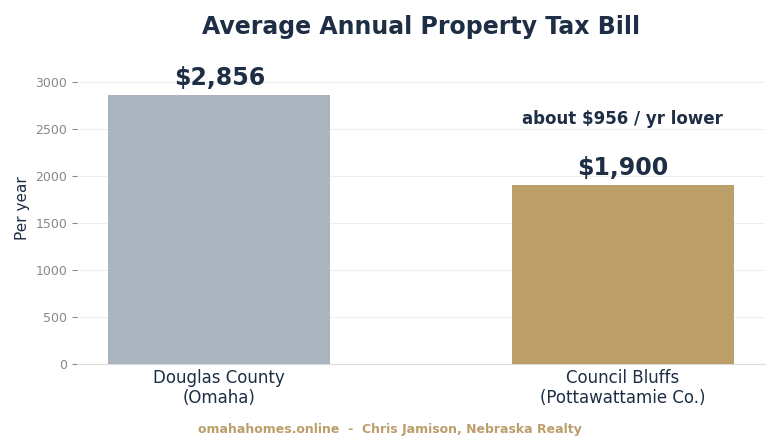
If you're moving from Omaha, you're leaving Nebraska's property tax structure behind — and that's a meaningful change. The average property tax bill in Douglas County runs around $2,856 per year. In Council Bluffs, that average drops to roughly $1,900. On a $250,000 home, that gap can be $800–$1,000 a year, every year, just in property taxes.
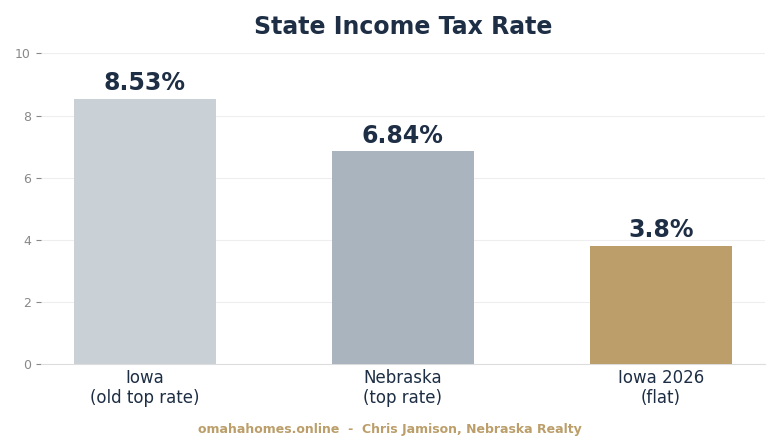
The income tax picture is also worth understanding. Iowa moved to a flat 3.8% income tax rate in 2026 — a dramatic shift from the old system that topped out at 8.53%. Nebraska's top rate sits at 6.84%. Depending on your income level, that difference can be significant over time. Iowa also fully exempts retirement income from state taxes, which matters a lot for buyers who are planning ahead. Most buyers I work with on the Iowa side are aware of the tax advantage going in — it's often what prompts the conversation in the first place.
The Home Prices: More for Your Money
Council Bluffs median home prices have been running around $225,000 — and the market is moving. Homes are going under contract in roughly two weeks with inventory extremely tight (well under a month of supply). Prices have held steady rather than spiking, which actually makes this a better entry point than you'd see in parts of the Omaha metro that have been running hotter. The combination of a competitive purchase price plus lower ongoing property taxes adds up fast when you run the numbers over five or ten years.
The housing stock itself is varied in a way that Omaha's newer suburbs aren't. Near downtown Council Bluffs, you'll find Victorian-era homes — real character, solid bones, the kind of architecture you just can't replicate. Council Bluffs actually predates Omaha historically, and that shows up in the older neighborhoods. On the outskirts of town, there are plenty of newer developments that feel similar to what you'd find in Papillion or La Vista. It really depends on what you're looking for. If you want a historic home with real personality, the area around downtown CB is worth serious attention. If you want a newer build in a quiet subdivision, those exist too.
The Stigma: What's Real and What's Not
Let's be honest — "Counciltucky" is a thing on the Omaha side of the river. And like most stereotypes, it's based on something real but overstated. There are neighborhoods in Council Bluffs with older, run-down buildings. There are also neighborhoods like that in Omaha. Neither city is monolithic, and the parts of Council Bluffs most buyers would actually consider are genuinely nice.
The more legitimate concern I hear from buyers isn't about the city itself — it's about the social reality of crossing the river. If you have family, friends, or routines firmly rooted on the Omaha side, you may find that people are less likely to make the trip east to come to you. Whether that's the bridge, the stigma, or just human inertia doesn't really matter — the effect is the same. It's worth thinking about honestly before you decide. If your social life is tightly tied to the west side, that's a real consideration. If you're more flexible, it probably won't matter much at all.
Free Download
Free Omaha Relocation Guide
Which neighborhoods fit your lifestyle, what homes really cost, and the biggest mistakes to avoid — written by a local Omaha Realtor.
Download Free →Who Council Bluffs Is Actually a Good Fit For
In my experience, Council Bluffs tends to work best for buyers who are budget-conscious and want to maximize what their dollar buys — especially first-time buyers or anyone who's been priced out of the Nebraska suburbs they originally wanted. It also works well for buyers who work in downtown Omaha or the south end of the metro, where the commute across the river is actually quite direct. Retirees and near-retirees who care about the income tax picture are another natural fit, now that Iowa's rate is so competitive.
On the other hand, if you have kids in Omaha-area schools you don't want to move, strong ties to a west-side neighborhood, or a job on the far west side of the metro, the calculus changes. It's not that Council Bluffs is wrong — it's that the tradeoffs matter more. I always tell buyers to be honest with themselves about where they actually spend their time before deciding the tax savings are worth it.
If you're weighing your options across the whole metro, the neighborhood quiz on my site can help you think through what kind of area actually fits your lifestyle. And if you want to compare Council Bluffs specifically against other parts of the Omaha metro, check out the Council Bluffs area page or browse the full relocation guide for a broader look at the metro.
Do I need a different real estate agent if I'm buying in Council Bluffs vs. Omaha?
Not necessarily — but you want someone who's licensed in Iowa and actually works that market. I'm licensed in both Nebraska and Iowa, so I work both sides of the river regularly. Make sure whoever you work with knows the Iowa contract process, which has some differences from Nebraska's forms.
Is Council Bluffs in the Omaha school district?
No. Council Bluffs has its own school district — the Council Bluffs Community School District. It's separate from OPS and any Nebraska district. If schools are a key factor in your decision, make sure you research the specific schools for the address you're considering. I wrote a full breakdown of the Council Bluffs Community School District if you want to dig in.
Will my homeowner's insurance change if I move to Iowa?
Potentially, yes. Insurance rates are set by state and by individual carriers. Some companies are competitive in both markets; others aren't. It's worth getting a quote specific to the Iowa address before you're under contract — don't assume your current carrier's rate will transfer directly.
Can I search for Council Bluffs homes the same way I search Omaha?
Mostly — but Council Bluffs and Omaha are actually on separate MLS systems. My site pulls from both, so you can search across the whole metro in one place. On Zillow or similar sites, you can browse both sides just fine, though occasionally a listing will appear twice if an agent entered it in both systems. The easiest thing is to use the Council Bluffs page on my site or the custom home search, which covers both markets.
Thinking About Making the Move?
I work both sides of the river — let's talk through what makes sense for your situation.
Recent Posts