Your Omaha Property Tax Bill, Explained Line by Line
Your Douglas County property tax bill is one page with about ten line items on it, and if you're like most homeowners I talk to, you've never read past the number at the bottom. I don't blame you. It's got a "consolidated levy" printed as a five-decimal number, a line for a natural resources district, and something called an Educational Service Unit. Nobody ever sat you down and explained any of it.
What This Post Covers
Every line on a Douglas County tax bill, who gets the money, why your assessed value doesn't actually set what you owe, and two tax credits that are easy to miss.
First: your assessed value doesn't set your tax bill
This is the single biggest misunderstanding I run into, and it trips up smart people constantly. When your valuation notice shows up in the spring and your home jumped $30,000, the natural reaction is "my taxes are going up." Maybe. But not for the reason you think.
Here's how it actually works. Omaha Public Schools, the City of Omaha, Douglas County — each one sets a budget first. They decide how many dollars they need. Then that total gets divided up among every property owner in the district. Your assessed value determines your share of the split. It does not determine the size of the bill.
Think about splitting a check at dinner with ten people. The restaurant decides what the food costs. You and your friends decide how to divide it. If you ordered the most, you pay the biggest share — that's your assessed value. But if everybody at the table orders 20% more food and the restaurant also raises prices 20%, your share of the check is exactly the same as before. What changed is the total.
"If every home in Douglas County went up 5% and the budgets stayed flat, your tax bill wouldn't change at all."
Which leads to the part that actually matters: your bill only goes up if (a) a taxing entity raises its budget, or (b) your home's value rose faster than your neighbors' did. If your house went up 8% and the county average went up 8%, you didn't lose ground. If yours went up 15% and the average went up 5%, you're now carrying more of the check than you were last year.
That's the real reason to look closely at your valuation notice — not because a higher number automatically costs you, but because a number that's high relative to comparable homes does. If yours looks out of line, you can protest it between June 1 and June 30 with the Douglas County Board of Equalization.
Where the money actually goes
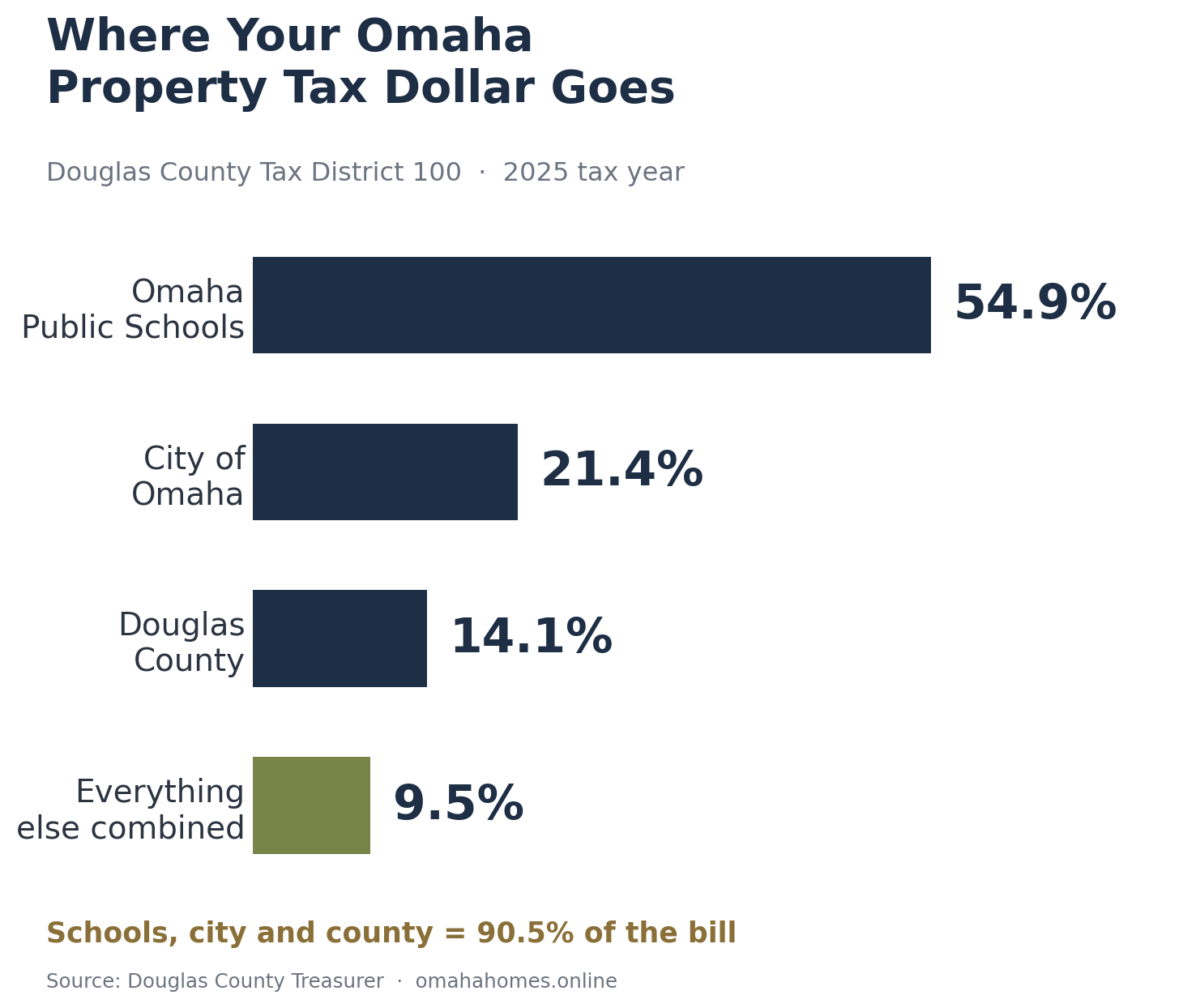
Here's a real 2025 Douglas County statement for a home in Tax District 100, one of the districts inside Omaha city limits. The consolidated levy was 2.05683 per $100 of taxable value. On a $300,000 home, that works out to roughly $6,170 a year before any credits.
Three entities take almost all of it. Omaha Public Schools alone is more than half your bill. Add the City of Omaha and Douglas County and you're at 90.5% — everything else on the statement, all six remaining lines put together, is under ten cents on the dollar.
Quick note on wording, because the county is precise about this even though the rest of us aren't. Your assessed value is what the assessor determines your property is worth — in Nebraska, residential property is assessed at 100% of market value. Your taxable value is that number after any exemptions come off. For most homeowners they're identical, which is why people use the terms interchangeably. If you have a homestead exemption, they aren't, and the levy applies to the taxable one. Your statement will say "Taxable Value."
Here's every line, with the exact levy:
| Who Gets It | Levy | Share |
|---|---|---|
| Omaha Public Schools | 1.13012 | 54.9% |
| City of Omaha | 0.43994 | 21.4% |
| Douglas County | 0.29059 | 14.1% |
| Metro Area Transit | 0.10000 | 4.9% |
| Papio-Missouri River NRD | 0.03035 | 1.5% |
| Metropolitan Community College | 0.02000 | 1.0% |
| City-County Building | 0.01700 | 0.8% |
| Educational Service Unit | 0.01500 | 0.7% |
| Learning Community Capital Project | 0.01383 | 0.7% |
| Metropolitan Utilities District | 0.00000 | 0.0% |
Worth keeping that proportion in mind before you get worked up about any one line item. And here's why there are so many names on there in the first place: in 1966 Nebraska voters passed an initiative that banned the state from levying property tax at all. Every dollar of it is levied by a local entity — a city, a county, a school board, a utility district, a transit authority. That's a big part of why this feels so slippery. There's no single office to call and no one body responsible. When taxes go up, each entity can honestly point at the others.
The lines nobody can explain at a party
Let me knock out the small ones, because these are the questions I actually get asked.
M.U.D. — you already know MUD. You pay them for water and gas every month. What confuses people is why they're also a line on the tax bill. The answer is that the Metropolitan Utilities District isn't a company — it's a separate unit of local government with its own elected board and its own authority to levy a property tax, the same as the city or the county.
So look at what it actually levied in 2025: zero. MUD runs on the rates you pay, not on property tax. The line stays on the bill because the authority exists, but that year it collected nothing. One other thing that trips people up — the "City of Omaha Sewer" charge on your monthly statement isn't MUD's money. MUD just does the billing for the city.
Metro Area Transit — buses and paratransit across Douglas and Sarpy counties and into Council Bluffs. It's its own political subdivision, governed by the Regional Metropolitan Transit Authority, and state law lets it levy up to 10 cents per $100. It's currently levying the full 10 cents, which is why it's the biggest of the small line items.
N.R.D. — the Papio-Missouri River Natural Resources District. Flood control, levees, water quality, and a good chunk of the trail system you probably use. Authorized up to 4.5 cents; currently around 3.
Educational Service Unit — a regional agency that provides shared services to school districts, like special education support and staff training. If you're in OPS, you're in ESU 19. Suburban Douglas County districts are in ESU 3.
Learning Community Capital Project — a Douglas and Sarpy levy funding early childhood learning centers and school facility projects across 11 districts. This one has a backstory most people have forgotten. Around 2005, Omaha Public Schools pushed a "one city, one school district" plan to annex chunks of the suburban districts, arguing the metro was splitting along racial and economic lines. The suburban districts fought hard to stay independent. The Legislature's compromise was LB 1024 in 2006, which left every district standing but put them all under a shared umbrella for certain purposes. The Learning Community is what's left of that fight, and this line on your bill is what it costs.
City-County Building — the name undersells it. This funds the Omaha-Douglas Public Building Commission, a joint city-county authority that builds and maintains the whole downtown government complex: the Civic Center at 1819 Farnam, the courthouse buildings, the historic Hall of Justice, and the grounds around them. At 1.7 cents per $100 it raises roughly $11 million a year.
It's not only upkeep, either. The Commission issues bonds for major construction — the new juvenile detention facilities were funded with $114 million in Building Commission bonds. So part of that line is maintenance and part is paying off buildings the county already put up.
One more that won't appear on the statement above but will on plenty of others: if you live in a newer subdivision in west Omaha, Elkhorn, Bennington, or parts of Papillion, you may have a SID levy instead of a city levy. That's a whole separate animal, and I wrote up how SID taxes work in Omaha if that's your situation.
Free Download
Free Omaha Home Seller's Guide
Step-by-step guide to pricing, timing, and maximizing your net proceeds when selling in the Omaha market.
Download Free →Why a "flat" levy can still raise your bill
Now that you know budgets come first and levies come second, this one clicks into place.
A levy is a rate, not a fixed dollar amount. When property values across the county rise and an entity holds its levy rate exactly where it was, it collects more money than it did last year — without ever voting to raise anything. Every homeowner writes a bigger check, and the entity gets to say it held the line.
That's not a conspiracy; it's just how the math works. But it's the reason "we're keeping the levy flat" and "your taxes aren't going up" are two different sentences. If a taxing body genuinely wanted to keep your bill flat while values rose 5%, it would have to cut the levy rate by roughly 5%.
There's a timing wrinkle here too, and it's worth understanding. Certified valuations don't reach the taxing entities until August 20. Budgets get finalized after that. So an entity can wait to see how much the tax base grew before deciding what to ask for — and if values came in hot, holding the rate steady quietly delivers a bigger budget. Nobody has to vote for an increase. Nobody has to defend one.
The law that makes them say it out loud
Nebraska got wise to this in 2021. A law called the Property Tax Request Act — most people call it Truth in Taxation — says that if a county, city, school district, or community college wants to increase its property tax request in dollars by more than 2% plus real growth, it has to come explain itself in public first.
Here's what that gets you, and it's more than you'd expect:
- A postcard in your mailbox, mailed by the county assessor at least seven days ahead, with "NOTICE OF PROPOSED TAX INCREASE" printed on it. It shows last year's and this year's assessed value of your property and what each entity took and wants to take.
- A joint public hearing — all the entities in one room, one night — held between September 17 and September 28, and required by law to start after 6 p.m. so working people can actually show up.
- That hearing is the only business conducted. No consent agenda, no zoning items to sit through. And anyone who wants to testify has to be given time.
- Each entity must state, out loud, the tax rate that would have collected the same number of dollars as last year — right next to the rate they're proposing. That's the whole "flat levy isn't flat taxes" problem, and the law makes them say the number.
That last one is the most useful sentence in this entire post. You don't have to do the math yourself or argue about whether a frozen rate counts as an increase. They have to tell you what revenue-neutral would have been. The gap between those two numbers is the answer.
Regular budget hearings happen too, through late summer, and the county board certifies the final levies in October. But if you're only going to pay attention once a year, the Truth in Taxation hearing in late September is the one.
Two credits worth knowing about
Nebraska has two property tax credits, and they work completely differently.
The School District Property Tax Credit is worth about 30% of the school district portion of your taxes — the biggest slice by far. Since 2024 it's been "frontloaded," meaning it's applied automatically as a reduction right on your tax statement. You don't claim it, you don't file for it, it's already baked in. This was a genuinely good change: under the old system, roughly 45% of Nebraskans never claimed a credit they were entitled to.
The Community College Property Tax Credit was not frontloaded. You still have to claim it yourself on your Nebraska income tax return. It's a smaller number, but it's real money that a lot of people leave on the table every year. Mention it to whoever does your taxes.
Now here's my actual complaint, and it's about the frontloaded one. It's applied automatically, which is good — but it's applied so quietly that most people don't know it happened. You won't find a line that says "here's what you saved." You'd have to multiply your school district taxes out yourself and compare. I've had clients who were certain they were getting no relief at all, when they'd already received the largest credit the state offers. Relief that nobody can see doesn't do the political work relief is supposed to do — people still feel like nothing's being done, because from where they're standing, nothing visible is.
If I could change one thing about the tax statement, it'd be that: show people the credit as its own line, in dollars, next to what they'd have paid without it.
The homestead exemption, and who has to refile
If you're 65 or older, or a disabled veteran, the Nebraska Homestead Exemption can wipe out part or all of your bill depending on income. It's a sliding scale — full relief at the bottom, phasing down in ten-point steps as income rises.
For most people it has to be refiled every single year, between February 1 and June 30, with the county assessor. Miss that window and you lose it for the whole year. There's no grace period and no retroactive fix.
There are exceptions, and this is the part almost nobody knows. Veterans with a 100% service-connected permanent disability rating or a 100% Individual Unemployability rating are on a longer cycle — the VA certification gets filed when first applying and then in years ending in 0 or 5, rather than annually. And for a paraplegic or multiple-amputee veteran, or an unmarried surviving spouse, living in a home the VA substantially contributed to, the certification doesn't have to be renewed at all once it's approved.
If you fall into one of those categories, confirm the details with the Douglas County Assessor rather than taking my word for it — the categories are specific and the paperwork differs by situation. The state also runs a Homestead Helpline at (888) 475-5101.
If my assessed value goes up, will my property taxes go up?
Not necessarily. Your assessed value determines your share of the total tax burden, not the total itself. If every property in the county rises by the same percentage and budgets stay flat, your bill stays roughly the same. Your bill goes up when a taxing entity increases its budget, or when your value rises faster than the average in your area.
When can I protest my property valuation in Douglas County?
Protests are filed with the Douglas County Board of Equalization between June 1 and June 30 each year. Filings outside that window can't be accepted. You can look up your property's record at dcassessor.org and check the details — square footage, bedroom and bathroom count, condition — since factual errors are among the easiest things to correct.
What is the consolidated levy on my Omaha tax bill?
It's the sum of every individual taxing authority's levy in your tax district, expressed per $100 of assessed valuation. For Tax District 100 inside Omaha in 2025 it was 2.05683, meaning about $2.06 in tax for every $100 of assessed value. Multiply your assessed value by the consolidated levy and divide by 100 to get your gross bill before credits.
Why is the school district such a large part of my bill?
Nebraska funds K-12 education more heavily through local property taxes than most states do. In Tax District 100, Omaha Public Schools accounts for roughly 55% of the consolidated levy. State law caps a school district's general fund levy at $1.05 per $100 of valuation, with bond and building funds levied separately on top of that.
None of this makes the bill smaller. But knowing which 55% of it is being decided at a school board meeting, and which 5% is buses, changes what you do with your attention — and it tells you whether the number on your valuation notice is worth fighting.
Is your assessed value anywhere near what your home would actually sell for?
Get a real market valuation based on what comparable Omaha homes are closing for right now — useful whether you're protesting an assessment or just curious.
Recent Posts