Iowa First-Time Home Buyer Programs Explained: IFA Loans for Council Bluffs & SW Iowa (2026)
If you're buying your first home in Council Bluffs or anywhere in southwest Iowa, there's a good chance the Iowa Finance Authority (IFA) program will come up — and there's a good chance you've never heard of it. Now officially operating under Iowa's Economic Development & Finance Authority, these state-backed programs work a lot like Nebraska's NIFA loans: below-market interest rates, down payment help, and a path to homeownership for buyers who can't quite make it work with a conventional loan alone. Here's what you need to know about how they work on the Iowa side of the river.
What This Post Covers
How Iowa's IFA loan programs work, who qualifies, the difference between FirstHome and Homes for Iowans, how the down payment assistance options compare, the $5,000 military homeownership grant for veterans and service members, the Iowa Title Guaranty closing cost advantage, what to expect at closing, and how the Council Bluffs market makes IFA offers easier to land than you might think.
What Is an IFA Loan?
IFA stands for Iowa Finance Authority — the state agency that has long provided affordable mortgage options to Iowa homebuyers. The agency has since been folded into Iowa's Economic Development & Finance Authority, but most lenders, buyers, and agents still refer to these programs as IFA loans, and that's how you'll hear them discussed in the Council Bluffs market.
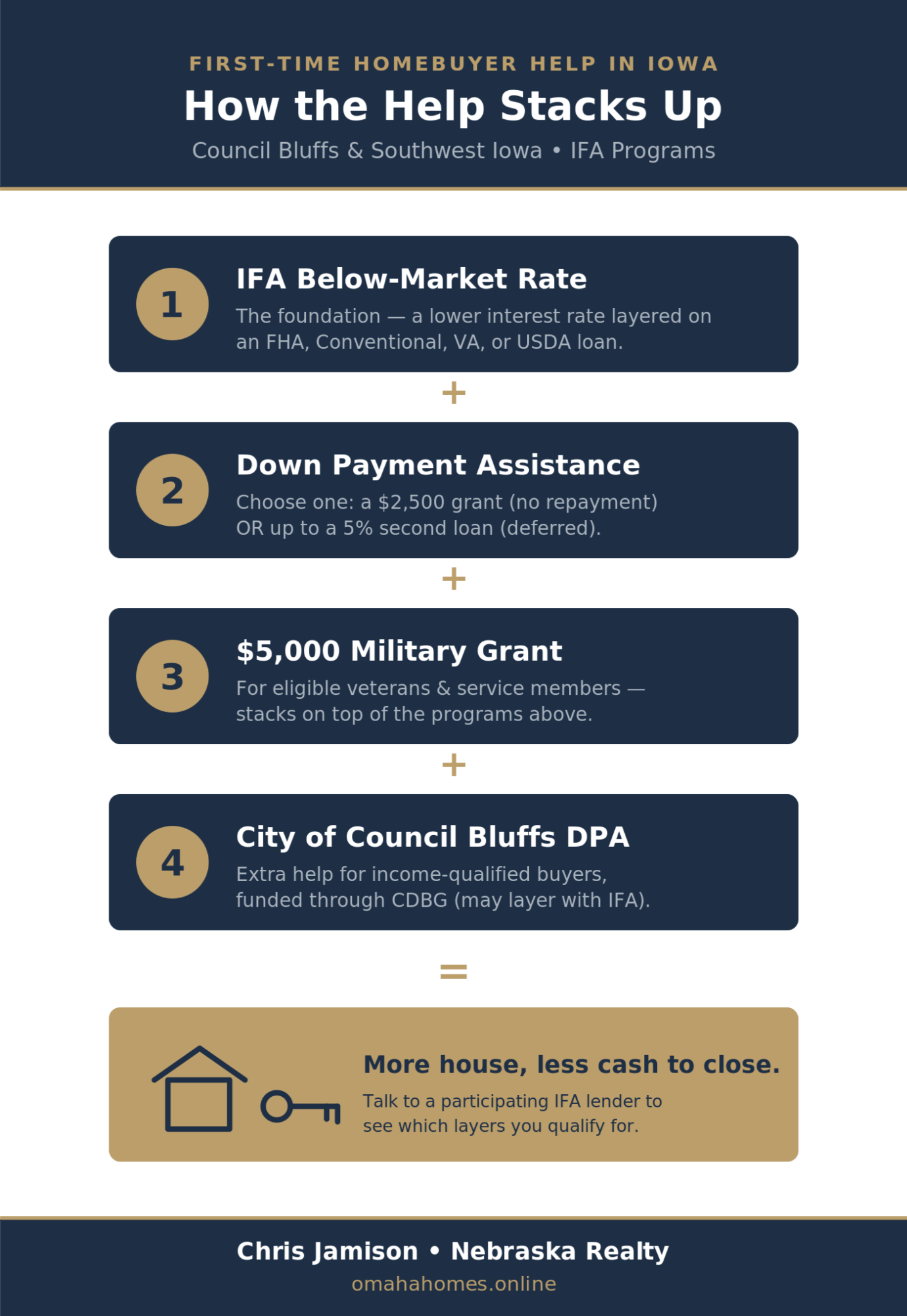
Like Nebraska's NIFA program, an IFA loan isn't a separate mortgage product — it's a below-market interest rate layered on top of a conventional, FHA, VA, or USDA mortgage. The state subsidizes the rate for qualified buyers, which can mean meaningful savings over the life of a 30-year loan. And also like NIFA, not every lender offers IFA — you need to work with an approved participating lender, and your agent should be able to point you to lenders who are actively doing these deals.
If you're buying in Omaha or elsewhere in Nebraska, check out our NIFA loan breakdown instead — the programs run parallel but are separate. IFA is Iowa-only; NIFA is Nebraska-only.
Who Qualifies?
IFA eligibility requirements are similar to what you'd find on the Nebraska side. Here are the key numbers to know for the Council Bluffs and southwest Iowa market:
Iowa's purchase price limit ($665,000) is notably higher than Nebraska's First Home program limit for non-targeted areas ($398,000). That gives Iowa buyers more room to work with, especially as home prices have climbed across the metro. Income limits vary by county and household size — the figures above represent the program maximum, and your specific county may be lower. Always confirm with a participating lender before assuming you're over or under the threshold.
The first-time buyer definition mirrors Nebraska's: you must not have owned and occupied a primary residence in the past three years. The Homes for Iowans program (covered below) waives this requirement entirely for repeat buyers.
Two Programs, Two Situations
Iowa's state homeownership programs split into two main options. Which one applies to you depends primarily on whether you've owned a home before:
| Program | Who It's For | Key Benefit |
|---|---|---|
| FirstHome | First-time buyers (no homeownership in the past 3 years) | Below-market rate; can be paired with down payment assistance |
| Homes for Iowans | First-time and repeat buyers — no ownership history requirement | More flexible income and purchase price limits; same rate benefit and DPA options |
The Homes for Iowans program is the one that often surprises buyers. It's genuinely open to repeat buyers — so if you sold a home two years ago and are now looking to buy in Council Bluffs, you're not automatically locked out of a state-backed rate. Not many programs across the country offer that flexibility, and it's one of the reasons I see IFA come up regularly on the Iowa side regardless of a buyer's ownership history.
Both programs require a minimum 3% down payment, a homebuyer education course before closing, and work with FHA, conventional, VA, and USDA loan products.
Down Payment Help: Grant or Loan — Pick One
Both IFA programs can be paired with down payment and closing cost assistance. Here's where it gets interesting: Iowa gives you a choice between two options, and you can use one or the other — not both.
| Option | What You Get | Repayment |
|---|---|---|
| $2,500 Grant | A flat $2,500 toward down payment or closing costs | None — it's a grant, free and clear |
| 5% Second Loan | Up to 5% of the purchase price — potentially much more than the grant | Due at sale, refinance, or payoff of first mortgage |
The math on the 5% loan is worth thinking through. On a $250,000 home, that's $12,500 — meaningfully more than the $2,500 grant. On a $300,000 home, it's $15,000. For buyers who are tight on cash to close, that second loan option can be the difference between getting there and not. Just know it's a deferred loan, not a gift — you'll repay it when the home sells or you refinance. Your lender can help you model out which option makes more sense for your specific situation.
Veterans & Service Members: The $5,000 Military Grant
If you've served, there's an extra layer of help most buyers never hear about. Iowa runs a Military Homeownership Assistance Program that adds a $5,000 grant toward your down payment and closing costs — and it stacks right on top of FirstHome or Homes for Iowans. My lending partner Erin Trescott flagged this one for me, and it's exactly the kind of benefit that's easy to leave on the table if your lender doesn't bring it up.
Here's the gist of who qualifies: eligible active-duty members, veterans, and certain surviving spouses who meet the program's service requirements. The home has to be in Iowa, you have to live in it as your primary residence within 60 days of closing, and you must get approved before you close — you can't apply for this one after the fact. Eligibility hinges on the specifics of your service record, so the right move is to have a participating lender confirm whether you qualify rather than guessing from a blog post.
One important caveat: this grant is funded year to year, and the money can run out before the fiscal year ends. So if you think you might be eligible, talk to a participating lender early — both to lock in your spot while funds last and to confirm the current year's allocation is still available. Erin Trescott is a good person to ask — she handles IFA and military grant deals on the Iowa side and helped me get the details on this program right.
"The market in Council Bluffs is less competitive than Omaha, which means an IFA offer doesn't raise the same eyebrows with sellers. That's one of the reasons it tends to go smoother over there — you're not usually competing against five conventional buyers."
The Iowa Title Guaranty: A Closing Cost Bonus
Iowa has something Nebraska doesn't: a state-run title program called Iowa Title Guaranty. Instead of purchasing private title insurance — which can cost hundreds or more depending on the home price — Iowa homebuyers can use the Title Guaranty program at a low flat fee. IFA borrowers can receive a free owner's certificate at closing.
This isn't going to tip the scale on whether IFA makes sense for you, but it's a real, tangible savings that most buyers don't know about until they see the closing disclosure. Think of it like the fee savings that come with a VA loan — not the headline benefit, but a nice added layer on top of the rate advantage. If you're comparing your estimated closing costs on an IFA deal versus conventional, that line item will look different in Iowa than it would in Nebraska.
What to Expect at Closing: The Honest Version
I want to be real with you about one thing: IFA closings can move a little differently than a straightforward conventional deal. The state has to sign off on the loan, and that approval layer adds a step to the process. I had a closing last year where we were waiting until the final hours for IFA to clear everything. The deal got done — but the stress was real, and the buyer felt every minute of it.
That's not a reason to avoid IFA. It's a reason to start early, work with a lender who does these regularly, and build some cushion into your closing timeline if you can. A lender who has done dozens of IFA closings knows how to stay ahead of that approval process. One who hasn't can leave you white-knuckling it at the end.
The Council Bluffs market does work in your favor here: it's generally less competitive than Omaha proper, so IFA buyers aren't usually fighting a bidding war timeline on top of the approval process. That matters. Sellers over there tend to be a little more patient, and your offer is less likely to be immediately undercut by a cash or conventional buyer.
Free Download
Free Omaha Home Buyer's Guide
A practical roadmap through every stage of buying — from pre-approval to closing — with local tips for both the Nebraska and Iowa sides of the metro.
Download Free →The City of Council Bluffs Has Its Own Program Too
On top of the state IFA programs, the City of Council Bluffs runs its own down payment assistance program funded through Community Development Block Grants (CDBG). It's designed for low-to-moderate income buyers and operates separately from the state IFA programs — meaning if you qualify, there may be a way to layer the two.
Worth knowing: the city currently has a new affordable housing development underway in the East Manawa area — 40 homes priced at $175,000 with $35,000 in down payment assistance available per unit. That's a significant opportunity for buyers in that price range and income bracket. For details on availability and how to apply, contact the City of Council Bluffs Community Development Department at (712) 890-5350.
I haven't personally worked a deal where a buyer stacked the city program and IFA together — those situations require some coordination and the right lender. But it's worth asking about if you're in the income range where both programs might apply.
How to Get Started
The starting point is the same as it is for any state-backed loan: talk to a participating lender before you do anything else. Not every lender in the Council Bluffs or Omaha market does IFA, and of those that do, you want one with recent, active experience on the Iowa side — not just technical approval.
Your agent matters here too. An agent who works both sides of the river regularly will know which lenders are solid on IFA deals and can make that introduction. If your agent can't give you a specific lender referral for Iowa programs, that's worth noting before you commit to working with them.
My Recommended IFA Lender
A big thank-you to Erin Trescott for helping me get the details right on this post — especially the military grant. She's a participating lender who actively does IFA deals on the Iowa side, which is exactly the kind of experienced hand you want when there's a state approval layer involved. If you're weighing an IFA loan in Council Bluffs, she's a great first call.
Visit Erin's Site →You'll also need to complete a homebuyer education course before closing — it's online, takes a few hours, and is required for both IFA programs. Get it done early; it's one less thing to scramble on in the final stretch.
Use the mortgage calculator on my site to run some rough numbers, and browse available homes through our custom home search if you want to see what's on the market in Council Bluffs in your price range. And if you're curious how the Iowa side compares to buying in Omaha or the Nebraska suburbs, the buyer's guide covers both markets.

Buying in Council Bluffs? Let's Talk.
I'm Chris Jamison with Nebraska Realty, and I work both sides of the river — Omaha and the Council Bluffs / southwest Iowa side. IFA deals have their quirks, but with the right lender and a little planning, they're one of the best paths I know of for first-time buyers. I can connect you with the right lender and walk you through what actually fits your situation — no pressure, just real guidance.
Let's Talk →Do I have to be a first-time buyer to use an IFA loan in Council Bluffs?
Not if you use the Homes for Iowans program. That program is open to both first-time and repeat buyers with no homeownership history requirement. The FirstHome program does require first-time buyer status (no homeownership in the last three years), but Homes for Iowans is the more flexible of the two and carries the same core rate benefits.
What's the difference between the $2,500 grant and the 5% loan?
The $2,500 grant is free money — no repayment required. The 5% second loan is up to 5% of the purchase price, which on most Council Bluffs homes will be significantly more than $2,500. The trade-off is that the loan must be repaid when you sell, refinance, or pay off your first mortgage. For buyers who are short on cash to close, the 5% loan often makes more mathematical sense — but your lender should model it out for your specific numbers.
Is there a special grant for veterans or military members?
Yes. Iowa's Military Homeownership Assistance Program offers a $5,000 grant toward down payment and closing costs for eligible service members, veterans, and certain surviving spouses, and it can be used alongside the FirstHome and Homes for Iowans programs. The home must be in Iowa and your primary residence within 60 days of closing, and you must be approved before closing. The program is funded annually and can run out of money before the fiscal year ends, so it's important to confirm eligibility and current funding with a participating lender early.
Can IFA loans be used with FHA, VA, or conventional mortgages?
Yes — IFA programs work with FHA, conventional, VA, and USDA loan products. The IFA layer provides the below-market rate and down payment assistance on top of whichever underlying loan type fits your profile best.
How does the closing process work differently with an IFA loan?
IFA loans require state sign-off in addition to the standard lender approval process. This adds a step that can sometimes create last-minute timeline pressure if it's not managed proactively. Working with a lender who has done IFA closings regularly — and building a little extra time into your closing date if possible — goes a long way toward keeping the process smooth.
Recent Posts