Omaha School Districts Compared: Grades, Graduation Rates & How to Choose (2026)
If you're moving to Omaha with kids, one of the first questions on your mind is probably: "Which school district should we be looking in?"
That's a smart question — and there's no single right answer. Omaha doesn't have one "best" district. It has several strong options, and the right fit depends on your commute, your housing budget, the neighborhood vibe you're after, and what kind of school environment you actually want for your kids. As a local Realtor who has helped a lot of families work through this decision, my honest take is that most of the metro's districts are genuinely solid — the bigger factor is usually figuring out which one matches your priorities, not chasing a ranking.
If you're still in the "we don't even know where to start" phase, begin with my Moving to Omaha guide, then come back here and use this page as your district cheat sheet.
🎥 Prefer to watch? I walked through all the main Omaha districts side by side — worth a look if you're in early research mode:
On This Page
Free Address Lookup
Already Know Your Address? Find Your District in Seconds.
Skip the scroll — enter any Omaha-area or Southwest Iowa address and get your district instantly.
Try the Free Lookup Tool →Free. No signup. Covers the full Omaha metro + Southwest Iowa.
Snapshot: Omaha Metro School Districts
Use this section to orient yourself by area, then click into the full district guide for boundaries, local context, and what it's actually like living there.
Central & East Omaha
OPS, Westside (District 66)
Southwest Omaha
Millard, Ralston
North/Northwest Growth
Elkhorn, Bennington
Sarpy County
Papillion-La Vista, Bellevue
Southwest Metro
Gretna
Iowa Options
Council Bluffs, Lewis Central, Treynor, Glenwood, Missouri Valley
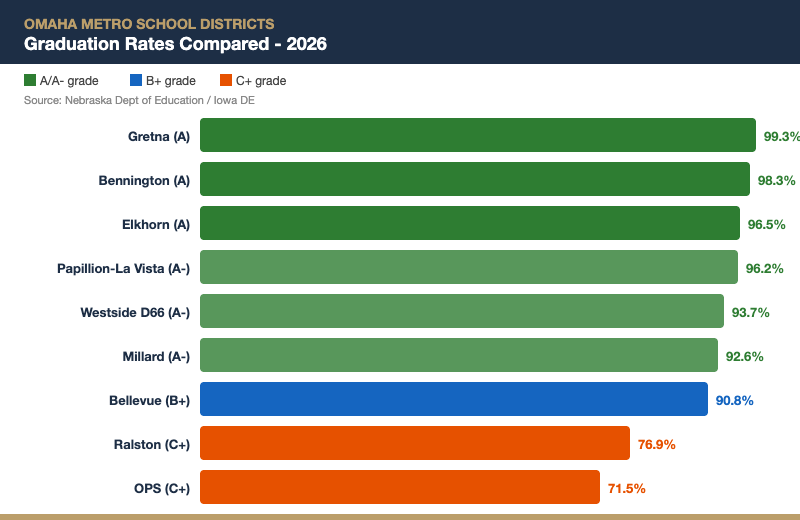
Data notes: Enrollment totals and graduation rates come from Nebraska Department of Education datasets. Niche grades are included as third-party context. Always verify boundaries and school assignment by address.
Omaha School Districts: Quick Compare
All the key numbers in one place. Click any district for the full breakdown including boundaries, neighborhoods, and what it's actually like to live there.
| District | Location | Enrollment | Grad Rate | Niche | Known For | Guide |
|---|---|---|---|---|---|---|
| Omaha Public Schools (OPS) | Central & East Omaha | 52,524 | 71.5% | C+ | Largest district, magnets, wide variety by school | Read |
| Millard Public Schools | Southwest Omaha | 23,253 | 92.6% | A- | Large suburban, strong outcomes, underrated value | Read |
| Elkhorn Public Schools | Far West / NW Omaha | 11,653 | 96.5% | A | High academics, newer housing, rapid growth | Read |
| Gretna Public Schools | Southwest metro | 7,013 | 99.3% | A | Fast growth, new development, expanding facilities | Read |
| Papillion-La Vista | Sarpy County | 12,069 | 96.2% | A- | Balanced value + performance, popular with Offutt families | Read |
| Westside (District 66) | Central-to-West Omaha | 6,330 | 93.7% | A- | Central location, established neighborhoods, commute-friendly | Read |
| Bennington Public Schools | North / NW metro | 4,381 | 98.3% | A | Smaller-district feel, fast growth, expanding campuses | Read |
| Bellevue Public Schools | South of Omaha | 9,502 | 90.8% | B+ | Established neighborhoods, strong military community | Read |
| Ralston Public Schools | Central/South-central | 3,491 | 76.9% | C+ | Compact district, clear boundaries, affordable areas | Read |
| Lewis Central CSD (IA) | SW Council Bluffs, IA | ~3,100 | — | B+ | Blue Ribbon HS, smaller district feel, Iowa side | Read |
What About Private Schools in Omaha?
In addition to public districts, Omaha has a wide range of private and parochial options — Catholic elementary and high schools throughout the metro, independent college-prep schools, Christian schools, and smaller faith-based and specialty campuses.
Private school tuition, admissions, and academic focus vary widely. Because private schools don't operate within public district boundaries, housing decisions may look different if private education is part of your plan.
Full guide to Omaha Private Schools →
Omaha Metro District Overviews
Omaha Public Schools (OPS)
Enrollment: 52,524 | Grad Rate: 71.5% | Niche: C+
OPS is the largest district in the state by a wide margin, covering North, South, Central, and much of East Omaha. If you're looking at Midtown, Benson, Dundee, Aksarben, or most of central Omaha, you're likely in OPS boundaries — but always verify by address. The district-wide C+ grade and lower graduation rate reflect averages across 52,000+ students — that's a lot of data, and size alone pulls those numbers in a direction that doesn't tell the whole story. What actually matters is the individual school. OPS offers career pathways, dual language programs, magnet schools, and early college options, and some of those programs are genuinely excellent. Don't write off an address just because it's in OPS — look at the specific school first.
Full breakdown of Omaha Public Schools →
Millard Public Schools
Enrollment: 23,253 | Grad Rate: 92.6% | Niche: A-
Millard covers much of southwest Omaha and, in my opinion, is one of the most underrated districts in the metro. The outcomes are strong — A- from Niche, 92.6% graduation rate — but it doesn't carry the same buzz as Elkhorn or Gretna. What you actually get is a large, well-rounded suburban district with IB pathways from elementary through high school, expanding STEM and dual language options, strong extracurriculars, and consistently solid results. And because you're largely buying established homes rather than new construction, the housing tends to give you more for your money. It doesn't get the hype it deserves.
Full breakdown of Millard Public Schools → | Millard neighborhood guide
Elkhorn Public Schools
Enrollment: 11,653 | Grad Rate: 96.5% | Niche: A
Elkhorn serves far west and northwest Omaha and is consistently rated among the top districts in the state. It's a great district — but it's not the be-all-end-all that some buyers treat it as. The housing stock skews newer and runs above the metro median, and you're trading a longer commute for those ratings. For some families, that's the right call. For others who compare what Millard or Papillion-La Vista offer closer in, the case for going all the way out west gets thinner.
Full breakdown of Elkhorn Public Schools → | Elkhorn neighborhood guide
Gretna Public Schools
Enrollment: 7,013 | Grad Rate: 99.3% | Niche: A
Gretna is southwest of Omaha and has expanded quickly alongside serious residential growth. Good test scores, strong community involvement, and a lot of new development make it a popular landing spot for families who want a small-town feel without sacrificing quality. One watch-out: parts of west Omaha can feed into Gretna depending on where the boundary falls, so always verify by address when comparing neighborhoods that look close on a map.
Full breakdown of Gretna Public Schools → | Gretna neighborhood guide
Papillion-La Vista Community Schools
Enrollment: 12,069 | Grad Rate: 96.2% | Niche: A-
Serving Papillion and La Vista in Sarpy County, this is one of the most popular "balanced" choices in the metro — strong outcomes without going all the way to the far edges of west Omaha. Two high schools, a solid STEM focus, and well-rounded programming that doesn't get overhyped. It's also the go-to district for Offutt-connected families and military relocators across Sarpy County, with commute times and housing options that tend to work well for that lifestyle.
Full breakdown of Papillion-La Vista → | Papillion neighborhood guide | La Vista neighborhood guide
Westside Community Schools (District 66)
Enrollment: 6,330 | Grad Rate: 93.7% | Niche: A-
Westside serves established neighborhoods between central and west Omaha. Strong in performing arts, gifted programs, and inclusion — one high school, but well-respected. The big practical perk is location: commute times are often shorter than outer suburban districts, especially if you work closer to Midtown, Downtown, or West O. Home prices run higher here, but so does the charm of the neighborhoods.
Full breakdown of Westside (District 66) → | Westside/66 neighborhood guide
Bennington Public Schools
Enrollment: 4,381 | Grad Rate: 98.3% | Niche: A
Bennington is north/northwest of Omaha and continues to expand its facilities as the area grows fast. It has the feel of a smaller district — strong parent and teacher engagement — while still being connected to metro amenities. A second high school is in the works as the community keeps building out.
Full breakdown of Bennington Public Schools → | Bennington neighborhood guide
Bellevue Public Schools
Enrollment: 9,502 | Grad Rate: 90.8% | Niche: B+
Bellevue sits just south of Omaha near Offutt Air Force Base. As a Veteran, I frequently work with military families here to maximize their BAH and navigate the VA loan process. It's known for established neighborhoods, practical commutes, and a strong military community presence. The existing housing stock also tends to give you solid value compared to newer-construction areas — more house for the money in a district that performs well. If you're coming in on orders, the 2026 BAH rates for Offutt are worth reviewing before you start your search.
Full breakdown of Bellevue Public Schools → | Bellevue neighborhood guide
Ralston Public Schools
Enrollment: 3,491 | Grad Rate: 76.9% | Niche: C+
Ralston is a compact district sandwiched between Millard and OPS territory. Smaller, affordable, walkable, and tight-knit — with a strong sense of safety and inclusion and clearly defined boundaries. Like OPS and Bellevue, the existing housing stock here tends to offer better value than areas dominated by new construction. Good fit for buyers who want to be close to the city without OPS-level district size.
Full breakdown of Ralston Public Schools → | Ralston neighborhood guide
Free Download
Free Omaha Home Buyer's Guide
A practical roadmap through every stage of buying — from pre-approval to closing — with local Omaha tips you won't find anywhere else.
Download Free →Iowa School Districts Near Omaha
Some families come into their search already open to living across the river. Others open up to it mid-search when they see what their budget gets them in Iowa vs. Nebraska. Either way, here are the main districts that come up.
Council Bluffs CSD
Enrollment ~8,300 | Grad Rate ~80% | Niche: C
Largest Iowa-side district. Two high schools and an early college program. Different grading system but strong programs and affordability.
Full guide →Lewis Central CSD
Enrollment ~3,100 | 15–25 min to Downtown | Niche: B+
SW Council Bluffs. Smaller, suburban-feeling district with a National Blue Ribbon high school and a $30M facility investment approved in 2024. A genuinely underrated Iowa-side option.
Full guide →Treynor CSD
Enrollment ~800 | Grad Rate ~95% | Niche: A
Smaller district, consistently strong ratings, rural acreage feel with a tight-knit community.
Full guide →Glenwood CSD
Enrollment ~2,070 | Grad Rate ~92% | Niche: B
Broader rural area south of Council Bluffs, solid overall ratings, rolling hills and established community feel.
Full guide →Missouri Valley CSD
Enrollment ~750 | Grad Rate ~90%+ | Niche: B-
Smaller district, lower student-to-teacher ratios, quieter community pace about 30–35 minutes from downtown Omaha.
Full guide →How to Choose the Right District
There's no single "best" district in Omaha — just the best one for you. If you're still early in the process, the Omaha Buyer's Guide is a good place to get oriented. Here's what actually moves the needle when you're narrowing things down:
Commute Reality
Daily drive beats rankings. Start with where you're working, then build out from there.
Housing Budget & Value
Districts heavy on new construction (Elkhorn, Gretna) run higher. OPS, Millard, Bellevue, and Ralston areas tend to give you more house for the money with existing homes — and the gap for a similar-sized house is often smaller than buyers expect.
Neighborhood Style
Older trees and character vs. new builds vs. acreage — each district has its own flavor.
District Size
Big system (OPS, Millard) vs. smaller footprint (Bennington, Westside) is a real preference difference for a lot of families.
Specific School
Boundaries matter more than the district name. Always verify by address — a house on one side of a street can be in a completely different district than the house across from it.
"Elkhorn gets a lot of attention — and it deserves it — but it's not the only answer. Millard is a great district that doesn't always get the credit it should."
If you want help narrowing things down, take the Omaha Neighborhood Quiz to match lifestyle to location, or check the Omaha Buyer's Guide for a broader look at neighborhoods and what the buying process looks like in this market. And if you're specifically weighing which suburb fits your family — schools plus commute, budget, and overall vibe — my best Omaha suburbs for families guide lays them out side by side.
Browse Homes by District
If school district is one of your must-haves, the fastest way to narrow things down is to see what's actually available in your budget right now. You can also start a custom home search filtered by area.
Frequently Asked Questions: Omaha School Districts
Which Omaha school district is best?
There isn't a single "best" — it depends on what your family actually needs. Most people start by narrowing based on commute and budget, then look at programs, size preference, and the specific schools tied to an address. Elkhorn, Gretna, and Bennington consistently earn the highest Niche grades — but Millard, Papillion-La Vista, and Westside are all strong options and often more practical depending on where you're landing in the metro.
Do school districts affect home prices in Omaha?
Yes, but maybe not in the way you'd expect. The bigger driver is often housing type, not just the district name. Areas heavy on new construction — like parts of Elkhorn and Gretna — run higher simply because you're buying newer homes. Districts like OPS, Millard, Bellevue, and Ralston tend to give you more house for the money because the existing housing stock offers better value. For a similar-sized home, the price gap between districts is often smaller than buyers assume going in.
How do I confirm which school district a home is in?
Always verify by address — never assume based on neighborhood name or zip code. Boundaries are tighter than most people expect, and they can change. A house on one side of a street can be in a completely different district than the house across from it. Use the free address lookup tool for a fast first check, then confirm with the district directly. Full address lookup guide + option enrollment explained →
What's the best school district in Omaha for families relocating from out of state?
For most relocating families, Millard and Papillion-La Vista are the most common landing spots — strong outcomes, manageable commutes to most parts of the metro, and a good range of housing price points. Elkhorn and Gretna are popular for families prioritizing top academic ratings who are fine with being further west. Westside is a great fit if you want to stay close to the city core. The Moving to Omaha guide has more context on all of these areas.
Is Omaha Public Schools (OPS) a good district?
It depends on the school. OPS is massive — over 52,000 students — and those district-wide statistics reflect that size. There are strong individual schools and magnet programs within OPS, and living in the OPS footprint puts you in the most central, walkable parts of the city. Don't write off an address just because it's in OPS without looking at the actual school tied to it first — especially at the elementary level.
Are there good schools near Offutt Air Force Base?
Yes. Papillion-La Vista and Bellevue Public Schools are the primary districts serving the Offutt area, and both are well-regarded. Papillion-La Vista is particularly popular with military families — a large, stable district with strong graduation rates and an A- Niche grade. Bellevue is more established and offers solid value on housing nearby. Check the 2026 BAH rates for Offutt if you're planning around your housing allowance.
What is Lewis Central school district and is it a good option?
Lewis Central Community School District serves southwest Council Bluffs and rural Pottawattamie County — the smaller, more suburban of the two Iowa-side districts. About 3,100 students, a National Blue Ribbon high school, and a $30M facility bond approved in 2024. It's a genuinely underrated option for families open to the Iowa side who want a smaller-district feel with strong academics. A lot of buyers who end up there weren't originally looking at Iowa — they found it when their budget opened things up across the river.
Ready to narrow it down?
Tell me your commute, budget, and a couple must-haves — I can usually point you to 1–2 districts and the specific neighborhoods worth looking at inside them.
Recent Posts